The role of Spec is undergoing a fundamental transformation, becoming the governance anchor of engineering systems in the AI era.
The Essence of Software Engineering and the Cost Structure Shift Brought by AI
From first principles, software engineering has always been about one thing: stably, controllably, and reproducibly transforming human intent into executable systems.
Artificial Intelligence (AI) does not change this engineering essence, but it dramatically alters the cost structure:
- Implementation costs plummet: Code, tests, and boilerplate logic are rapidly commoditized.
- Consistency costs rise sharply: Intent drift, hidden conflicts, and cross-module inconsistencies become more frequent.
- Governance costs are amplified: As agents can act directly, auditability, accountability, and explainability become hard constraints.
Therefore, in the era of Agent-Driven Development (ADD), the core issue is not “can agents do the work,” but how to maintain controllability and intent preservation in engineering systems under highly autonomous agents.
The ADD Era Inflection Point: Three Structural Preconditions
Many attribute the “explosion” of ADD to more mature multi-agent systems, stronger models, or more automated tools. In reality, the true structural inflection point arises only when these three conditions are met:
Agents have acquired multi-step execution capabilities
With frameworks like LangChain, LangGraph, and CrewAI, agents are no longer just prompt invocations, but long-lived entities capable of planning, decomposition, execution, and rollback.
Agents are entering real enterprise delivery pipelines
Once in enterprise R&D, the question shifts from “can it generate” to “who approved it, is it compliant, can it be rolled back.”
Traditional engineering tools lack a control plane for the agent era
Tools like Git, CI, and Issue Trackers were designed for “human developer collaboration,” not for “agent execution.”
When these three factors converge, ADD inevitably shifts from an “efficiency tool” to a “governance system.”
The Changing Role of Spec: From Documentation to System Constraint
In the context of ADD, Spec is undergoing a fundamental shift:
Spec is no longer “documentation for humans,” but “the source of constraints and facts for systems and agents to execute.”
Spec now serves at least three roles:
Verifiable expression of intent and boundaries
Requirements, acceptance criteria, and design principles are no longer just text, but objects that can be checked, aligned, and traced.
Stable contracts for organizational collaboration
When agents participate in delivery, verbal consensus and tacit knowledge quickly fail. Versioned, auditable artifacts become the foundation of collaboration.
Policy surface for agent execution
Agents can write code, modify configurations, and trigger pipelines. Spec must become the constraint on “what can and cannot be done.”
From this perspective, the status of Spec is approaching that of the Control Plane in AI-native infrastructure.
The Reality of Multi-Agent Workflows: Orchestration and Governance First
In recent systems (such as APOX and other enterprise products), an industry consensus is emerging:
- Multi-agent collaboration no longer pursues “full automation,” but is staged and gated.
- Frameworks like LangGraph are used to build persistent, debuggable agent workflows.
- RAG (e.g., based on Milvus) is used to accumulate historical Specs, decisions, and context as long-term memory.
- The IDE mainly focuses on execution efficiency, not engineering governance.
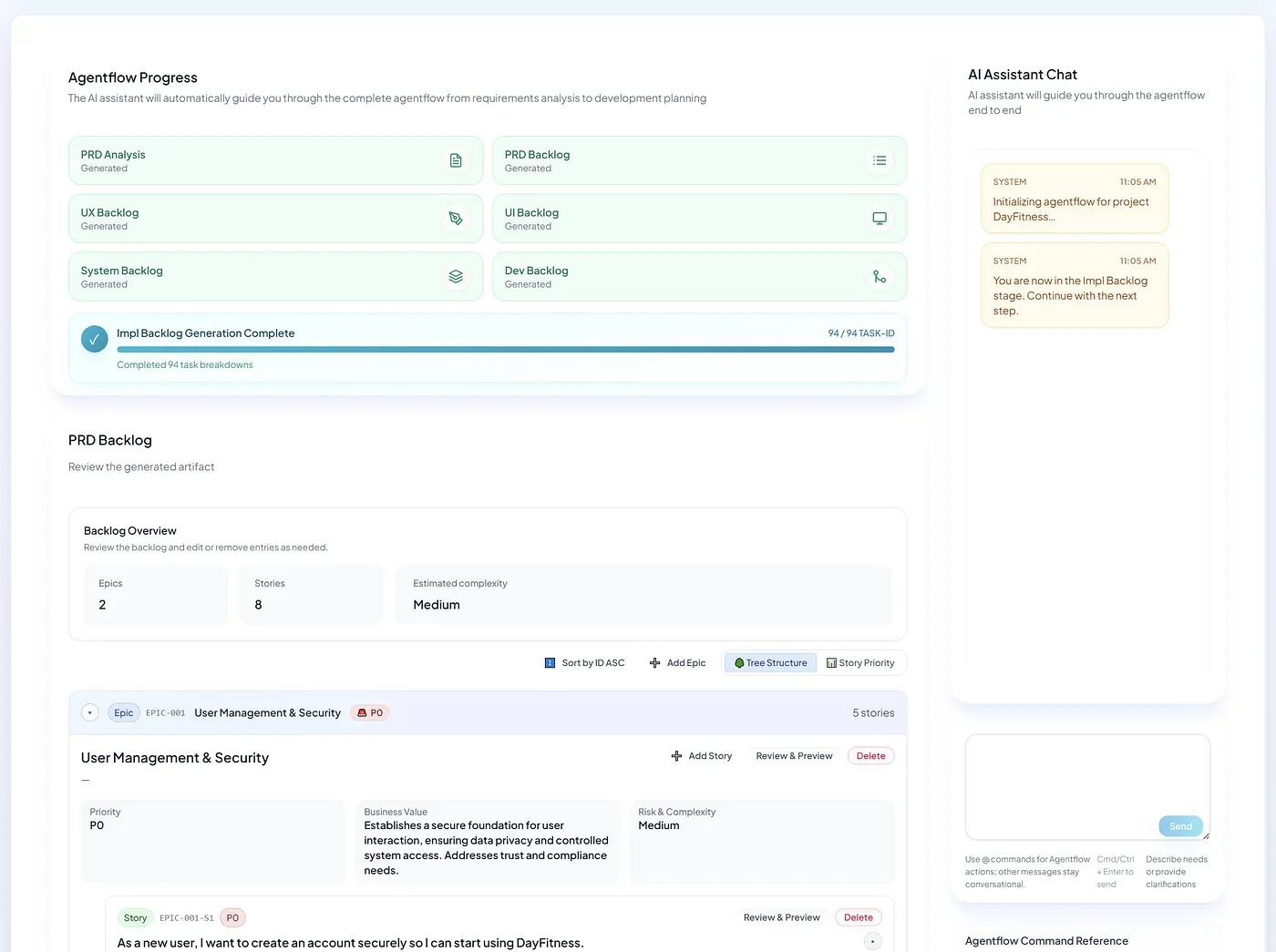
APOX (AI Product Orchestration eXtended) is a multi-agent collaboration workflow platform for enterprise software delivery. Its core goals are:
- To connect the entire process from product requirements to executable code with a governable Agentflow and explicit engineering artifact chain.
- To assign dedicated AI agents to each delivery stage (such as PRD, PO, Architecture, Developer, Implementation, Coding, etc.).
- To embed manual approval gates and full audit trails at every step, solving the “intent drift and consistency” governance problem that traditional AI coding tools cannot address.
- The platform provides a VS Code plugin for real-time sync between local IDE and web artifacts, allowing Specs, code, tasks, and approval statuses to coexist in the repository.
- Supports assigning different base models to different agents according to enterprise needs.
APOX is not about simply speeding up code generation, but about elevating “Spec” from auxiliary documentation to a verifiable, constrainable, and traceable core asset in engineering—building a control plane and workflow governance system suitable for Agent-Driven Development.
Such systems emphasize:
- An explicit artifact chain from PRD → Spec → Task → Implementation.
- Manual confirmation and audit points at every stage.
- Bidirectional sync between Spec, code, repository, and IDE.
This is not about “smarter AI,” but about engineering systems adapting to the agent era.
The Long-Term Value of Spec: The Core Anchor of Engineering Assets
This is not to devalue code, but to acknowledge reality:
- There will always be long-term differentiation in algorithms and model capabilities.
- General engineering implementation is rapidly homogenizing.
- What is hard to replicate is: how to define problems, constrain systems, and govern change.
In the ADD era, the value of Spec is reflected in:
- Determining what agents can and cannot do.
- Carrying the organization’s long-term understanding of the system.
- Serving as the anchor for audit, compliance, and accountability.
Code will be rewritten again and again; Spec is the long-term asset.
Risks and Challenges of ADD: Living Spec and Governance Constraints
ADD also faces significant risks:
Can Spec become a Living Spec
That is, when key implementation changes occur, can the system detect “intent changes” and prompt Spec updates, rather than allowing silent drift?
Can governance achieve low friction but strong constraints
If gates are too strict, teams will bypass them; if too loose, the system loses control.
These two factors determine whether ADD is “the next engineering paradigm” or “just another tool bubble.”
The Trend Toward Control Planes in Engineering Systems
From a broader perspective, ADD is the inevitable result of engineering systems becoming “control planes”:
Engineering systems are evolving from “human collaboration tools” to “control systems for agent execution.”
In this structure:
- Agent / IDE is the execution plane.
- RAG / Memory is the state and memory plane.
- Spec is the intent and policy plane.
- Gates, audit, and traceability form the governance loop.
This closely aligns with the evolution path of AI-native infrastructure.
Summary
The winners of the ADD era will not be the systems with “the most agents or the fastest generation,” but those that first upgrade Spec from documentation to a governable, auditable, and executable asset. As automation advances, the true scarcity is the long-term control of intent.