Statement
ArkSphere has no affiliation or association with McKinsey Ark.
The greatest value of Ark lies in reshaping engineering paradigms, not just its features. It points the way for AI Infra and leaves vast space for community ecosystems.
Recently, many members in our ArkSphere community have started exploring McKinsey’s open-source Ark (Agentic Runtime for Kubernetes).
Some see it as radical, some think it’s just a consulting firm’s experiment, and others quote a realistic maxim:
What we need now is “agentic runtime realism,” not “unified model romanticism.”
I strongly agree with this sentiment.
I’ve spent some time analyzing Ark’s source code, architecture, and design philosophy, combined with our community discussions. My conclusion is:
Ark’s significance is not in its features, but in its paradigm.
It’s not the answer, but it points toward the future of AI Infra.
Below is my interpretation of Ark, focusing on engineering, architecture, trends, and its inspiration for ArkSphere.
What Exactly Is Ark?
Ark’s core positioning is: A runtime that treats Agents as Kubernetes Workloads.
It’s not a framework, not an SDK, not an AutoGen-style multi-agent tool, but a complete system including:
- Control plane (Controller)
- Custom resource models (CRD, Custom Resource Definition)
- API service
- Dashboard
- CLI
- Python SDK
Essentially, Ark is the control plane for Agents.
Ark defines seven core CRDs in Kubernetes. The following flowchart shows the relationships among these resources:

Through this set of CRDs, Ark makes Agent systems resource-oriented and declarative, enabling capabilities such as:
- Lifecycle management
- Multi-tenant isolation
- RBAC (Role-Based Access Control)
- Observability
- Upgradability
- Extensibility (tools, models, MCP)
In other words, Ark is not about “how to write Agents,” but “how to operate Agents in enterprise-grade systems.”
Three-Layer Architecture: Mixed Languages and Components, but a Complete System
Ark’s overall architecture is divided into three layers, each with different tech stacks and responsibilities. The following flowchart illustrates the relationships among components in each layer:

This is not a “wrapper project,” but a fully operational AI Runtime system, with a level of engineering far beyond most agent frameworks on the market.
Is It the Kubernetes of the AI Era?
Let’s revisit Kubernetes’ core value:
Kubernetes was never about “unifying cloud APIs”; it unified the “application runtime model.”
Cloud provider APIs aren’t unified, nor are networking or storage. What is unified: Pod, Deployment, Service—these application models.
Kubernetes succeeded because:
It provides a stable application abstraction on top of diversity.
Ark’s goal is not to unify all large language models (LLMs), MCPs, or tool formats, but rather:
Agent resource model (CRD) + control plane (Reconciler) + lifecycle.
From this perspective, Ark offers a prototype of a “declarative application model” for the AI era.
Whether it will become “Kubernetes for AI” is still too early to say, but it has already planted a seed.
Comparison with Other Frameworks: Not on the Same Level
Current mainstream agent frameworks like LangChain, CrewAI, AutoGen, MetaGPT, etc., address problems fundamentally different from Ark.
The table below compares the positioning and limitations of each framework:
| Name | What Problem Does It Solve | Core Limitation |
|---|---|---|
| LangChain | Agent/Tool composition | Doesn’t address deployment or governance |
| AutoGen | Multi-agent conversations | Lacks control plane and lifecycle |
| CrewAI | Workflow-style multi-agent | Missing scheduling, RBAC, resource model |
| MetaGPT | Agent SOP | Just execution logic, not a platform |
| OpenDevin | AI IDE/Dev Assistant | Not an Agent Runtime |
| Ark | Agent control plane + resource system | Functionality not yet mature |
In short:
- Other tools focus on “how to write Agents.”
- Ark focuses on “how Agents run, schedule, govern, observe, and extend.”
That’s an architectural difference.
Execution Flow: Agents Scheduled Like Pods
Ark’s execution flow closely resembles the Kubernetes controller model. The following sequence diagram shows the core process:
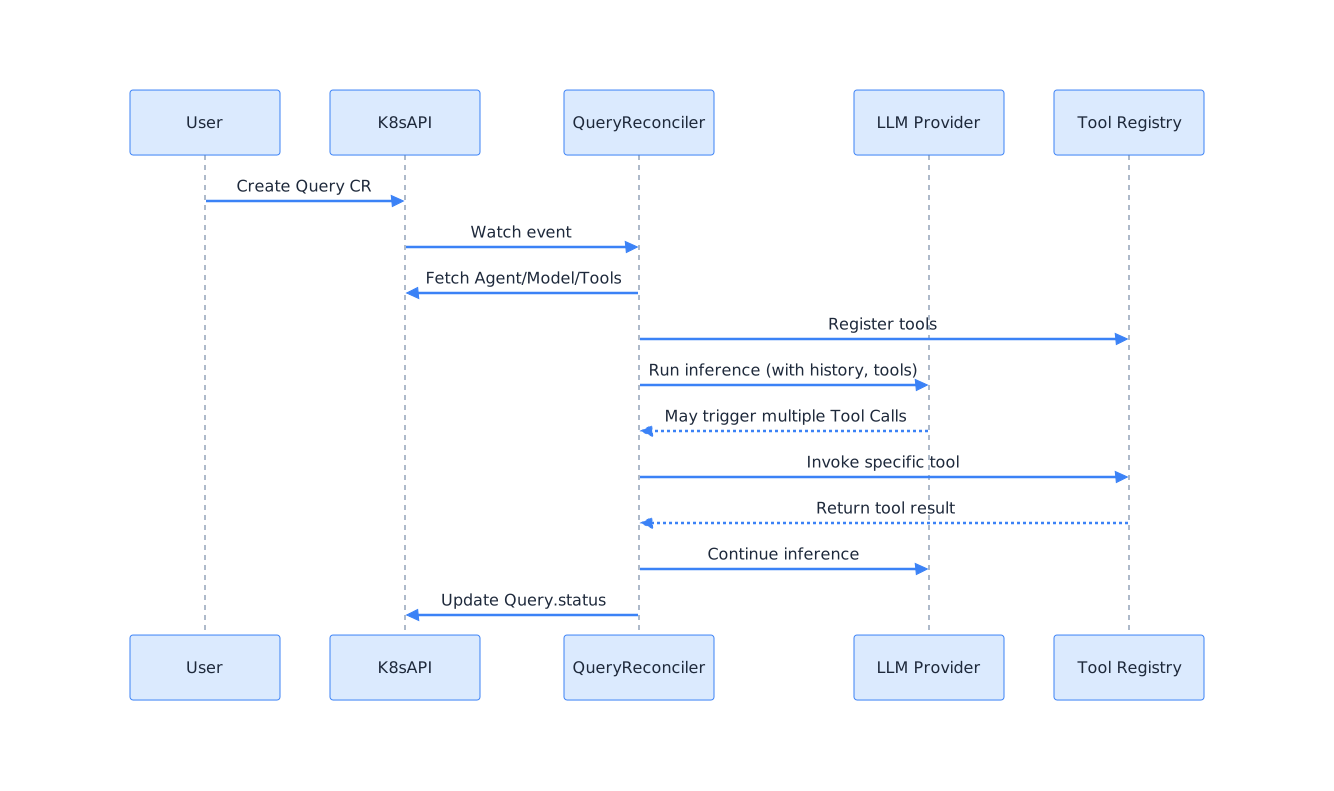
You can see Ark’s process logic is transparent, with a clear engineering path, bringing agent systems into a “controllable” state.
Production Readiness: Right Direction, Still a Tech Preview
According to official notes and code maturity, Ark currently offers:
- Runnable
- Learnable
- Extensible
- But not recommended for large-scale production use yet
Main reasons include:
- CRD structures may change
- APIs are not yet stable
- MCP ecosystem is still forming
- Memory service is still basic
- Multi-agent team execution strategies are primitive
But the engineering system is already taking shape, which is crucial.
Community Activity: Small but Elite, Strong McKinsey Drive
From GitHub data:
- Stars: 222
- Forks: 50
- Contributors: 48
- Commit frequency is steady
- The vast majority of contributions come from within McKinsey
Note: Data as of December 2, 2025.
High stability, but limited openness.
This is also ArkSphere’s opportunity:
The paradigm is right, but the ecosystem needs community-driven growth.
Trends for 2026: From Framework Era to Runtime Era
After deep analysis, I’m increasingly convinced:
- 2023–2024: Large model API call era
- 2024–2025: Agent framework era
- 2025–2027: Agent Runtime / Control Plane era (Ark’s direction)
While everyone is writing Python scripts for agents, the real value lies in:
- Multi-agent task scheduling
- Tool registration and governance
- Session/Memory lifecycle
- Result reproducibility
- RBAC, auditing, tenant isolation
- Observability
- Enterprise internal personalized agent systems
Ark is providing a practical path forward.
Inspiration for ArkSphere
Ark’s inspiration for ArkSphere is both critical and direct:
ArkSphere Should Focus on “Paradigm Building,” Not “Feature Stacking”
Ark offers a prototype for future Agentic Runtime:
- Resource model
- Control plane
- Tool registration
- Multi-agent collaboration
- Evaluation and governance
ArkSphere’s role should be:
Aggregate paradigms, produce standards, incubate ecosystems, not rewrite Ark itself.
This is the “CNCF (Cloud Native Computing Foundation) for the AI-native era.”
Huge Potential for Localization in China
Localization opportunities include but are not limited to:
- Integration with domestic large language models (e.g., Qwen, DeepSeek, Zhipu)
- Enterprise privatization scenarios
- Local tool/MCP discovery ecosystem
- Multi-cluster/edge inference
- Enterprise-grade RBAC, auditing, data isolation
- AgentSpec enhancements for industrial scenarios
- Enhanced versions of Runtime/Controller
In other words:
Ark solves the “model,” while ArkSphere can solve the “ecosystem.”
What We Need Is Not “Kubernetes for the LLM Era,” But an “Industry-Grade Cognition System for AI Runtime”
The biggest takeaway from dissecting Ark:
The future of AI-native is not a pile of tools, but an engineering system.
ArkSphere can be the initiator of this system.
Summary
Ark is not a “universal runtime,” nor is it the “ultimate Kubernetes for the AI era.”
But it has done one crucial thing right:
It abstracts all the pain points people faced when writing Python agent scripts into Kubernetes resources and controllers.
It represents engineering, not just a demo.
It’s not mature yet, but it’s heading in the right direction.
It’s not the end, but it gives us a clear roadmap.
For the ArkSphere community I’m running, Ark provides a clear inspiration:
The future belongs to Runtime, to Control Plane, to governable agent systems.
And the ones who can truly scale this system are not McKinsey, but the community.