Recently, the Cilium project released its 2024 annual report, available on GitHub. This report details the major achievements Cilium has made over the past year and looks forward to its future development in cloud-native networking and security. Since its initial commit nearly ten years ago, the Cilium project has maintained strong momentum and is leading new transformations in cloud-native networking and security.
Cilium’s Outstanding Development
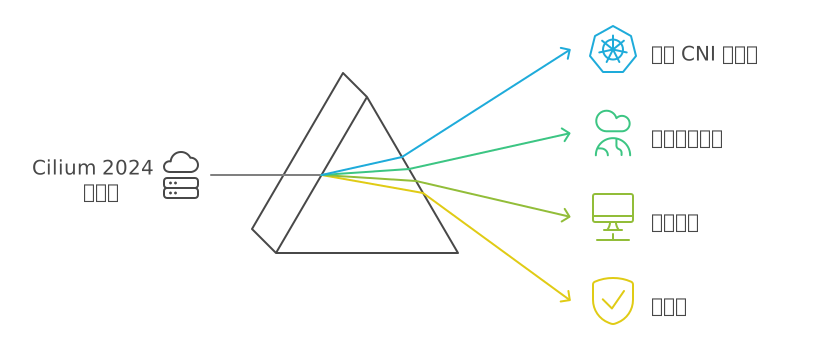
2024 was a crucial year in Cilium’s development. It not only consolidated its position as the de facto standard CNI for Kubernetes but also evolved into a comprehensive networking stack for Kubernetes environments. Cilium’s evolution demonstrates its exceptional ability to address modern cloud-native environment challenges, expanding from an initial pod-to-pod connectivity solution to a unified project covering networking, observability, and security - all driven by eBPF technology.
Key Milestones and Major Achievements
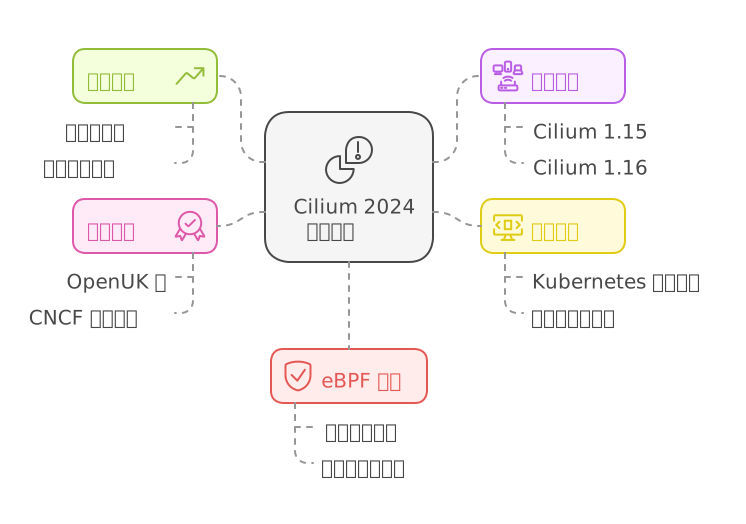
- Thriving Community: The Cilium community continues to grow, with increasing numbers of contributors and contributing organizations. Users span numerous industries including finance, logistics, media, and telecommunications. Since joining CNCF, the number of contributing organizations has grown by 90%, reaching 1,011, and individual contributors have grown by 252%, reaching 4,464. Cilium is also the third fastest-growing project in the CNCF ecosystem.
- Technical Innovation: In 2024, Cilium released two major versions, 1.15 and 1.16, bringing numerous innovative features.
- Cilium 1.15: Introduced comprehensive support for Gateway API 1.0, doubled Cluster Mesh scalability, enhanced observability by associating traffic with network policies, and expanded BGP functionality to better integrate with external systems.
- Cilium 1.16: With the theme “faster, stronger, smarter,” it eliminated virtual network overhead through netkit, achieving performance parity between hosts and containers; introduced BGPv2 API, supporting user-defined complex network policies; added multicast data path support; and significantly optimized CPU and memory usage while reducing tail latency by up to 5 times.
- Widespread Adoption: User surveys show that Cilium is gradually taking over the Kubernetes networking stack. Features like Cluster Mesh, BGP, and Gateway API are already widely used in production environments. 95% of respondents run multiple Kubernetes clusters, and Cilium has been rated as a top multi-cluster management tool in the CNCF Technology Radar.
- Industry Recognition: Cilium won the OpenUK 2024 Open Source Software Award. Additionally, in the CNCF Multi-Cluster Management Technology Radar, Cilium was rated as the most adoptable technology, receiving highest scores in both practicality and maturity.
- eBPF Security: The eBPF Foundation released two important research reports, enhancing security and operational guidance for eBPF-based deployments:
- eBPF Security Threat Model: Detailed potential risks of eBPF and provided corresponding mitigation strategies.
- eBPF Verifier Code Audit: Emphasized the verifier’s role in ensuring eBPF deployment security and proposed improvement suggestions.
User Feedback and Use Cases
Feedback and cases from users further confirm Cilium’s advantages in performance, cost-effectiveness, and functionality. Users generally agree that Cilium effectively reduces network costs and CPU consumption while providing excellent performance and low latency. Additionally, Cilium’s observability tools (such as Hubble) and network policy functionality have received widespread praise from users.
Future Outlook
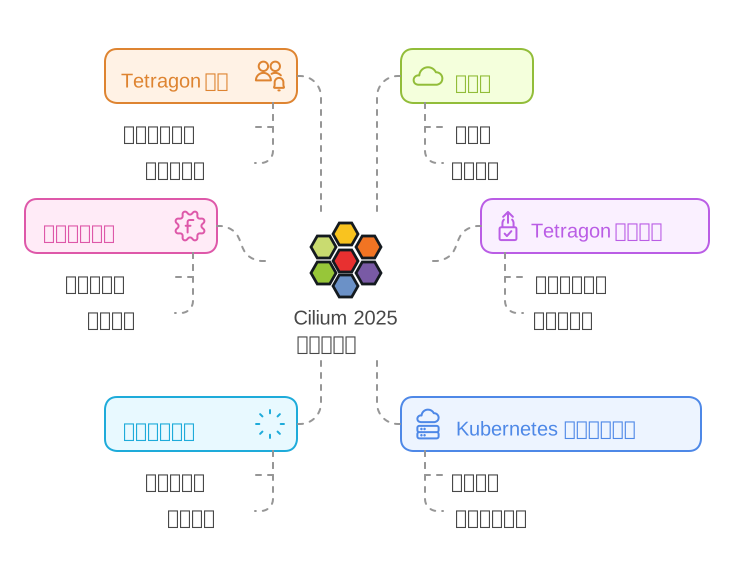
Looking ahead to 2025, Cilium’s development momentum will continue to strengthen. Platform engineering and integration trends are reshaping how organizations manage Kubernetes networking, and Cilium is at the core of this transformation. We expect:
- The Cilium stack will further integrate networking functions.
- Tetragon will see more widespread application in advanced security observability.
- Cilium will more deeply integrate external and traditional workloads into Kubernetes environments.
- Cilium will be widely used not only as a CNI but also as a comprehensive Kubernetes networking solution.
- Tetragon will continue to evolve, providing more powerful detection capabilities and more actionable threat response solutions.
- Cilium’s hybrid cloud and multi-cloud integration will play an even greater role in 2025.
Cilium’s support for external workloads, Layer 4 load balancing, and BGP enhancements will bridge the gap between Kubernetes-native systems and traditional systems.
Summary
The Cilium project achieved tremendous success in 2024, establishing its leadership position in Kubernetes networking. Cilium is more than just a CNI - it’s a comprehensive Kubernetes networking solution covering networking, observability, and security. As cloud-native technology continues to evolve, Cilium will continue to lead industry innovation, providing users with more powerful and reliable cloud-native networking solutions.
Note: Images in this article were created using napkin.ai.