Haze on arrival, and a cracked “Garden City” illusion: a fitting metaphor for where cloud native finds itself.
This was my first time in Singapore.
Before the trip, my mental image of the city was clean, green, and efficient, maybe even too perfect. What greeted me on arrival was an overcast sky. Friends there told me the haze had hung around for days, and the legendary “Garden City” filter cracked a little.
Of course, that is not necessarily Singapore’s own doing. Air does not stop at national borders, and environmental impact is never isolated. Thinking about it later, it works as a metaphor: whether it is the natural environment, a commercial ecosystem, or an open source technology ecosystem, we all live inside interdependent systems where nobody can truly stay clean on their own.
That feeling only grew stronger at ContainerDays Singapore 2026: the cloud native community is going through something very similar.
A City Built for Business, an Ecosystem in Transition
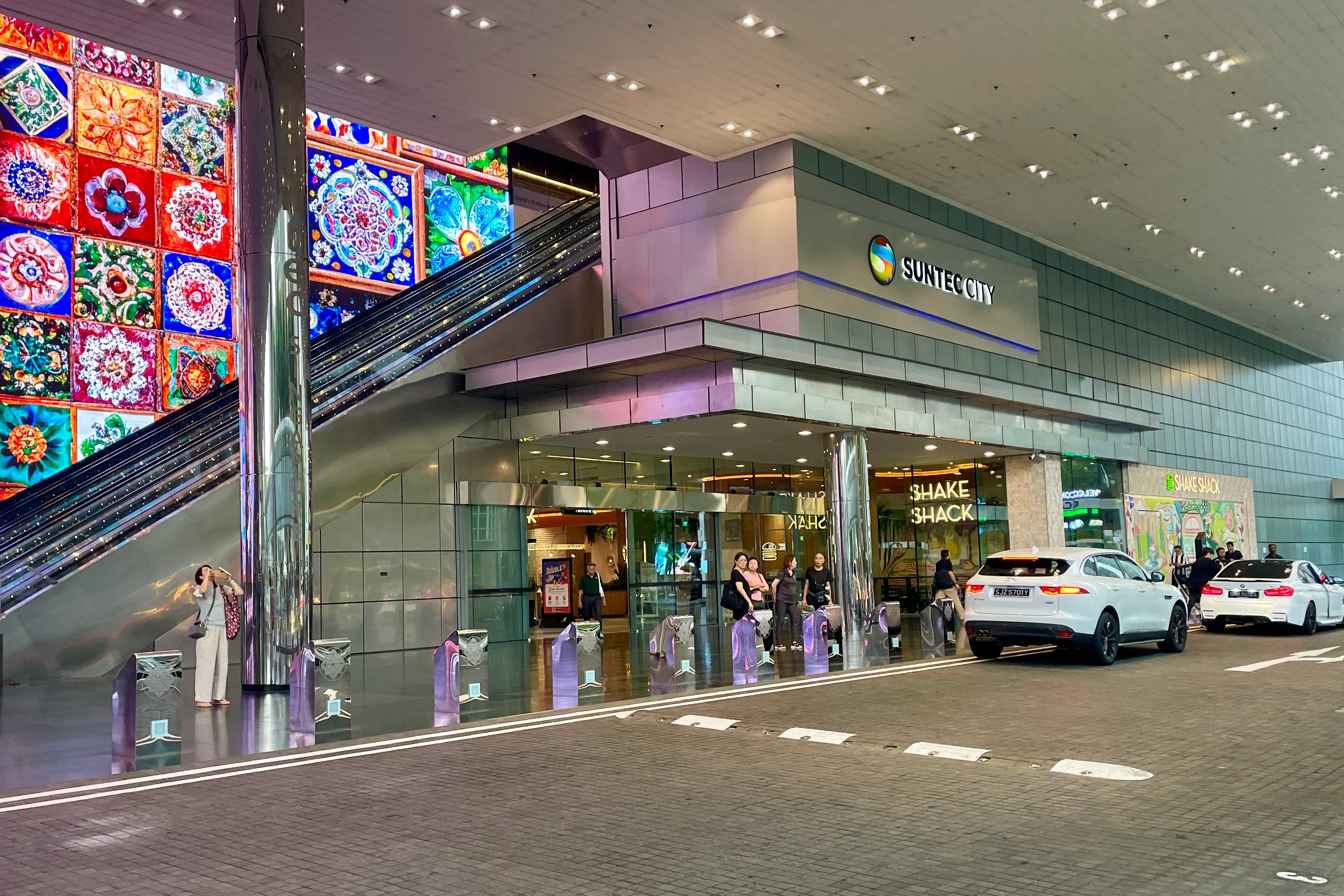
ContainerDays took place at Suntec City. The venue infrastructure is mature, other events were running at the same time, and people from different countries and industries gathered there to meet, exchange ideas, and look for partnerships. Singapore really is a comfortable place to hold an international conference and do business.
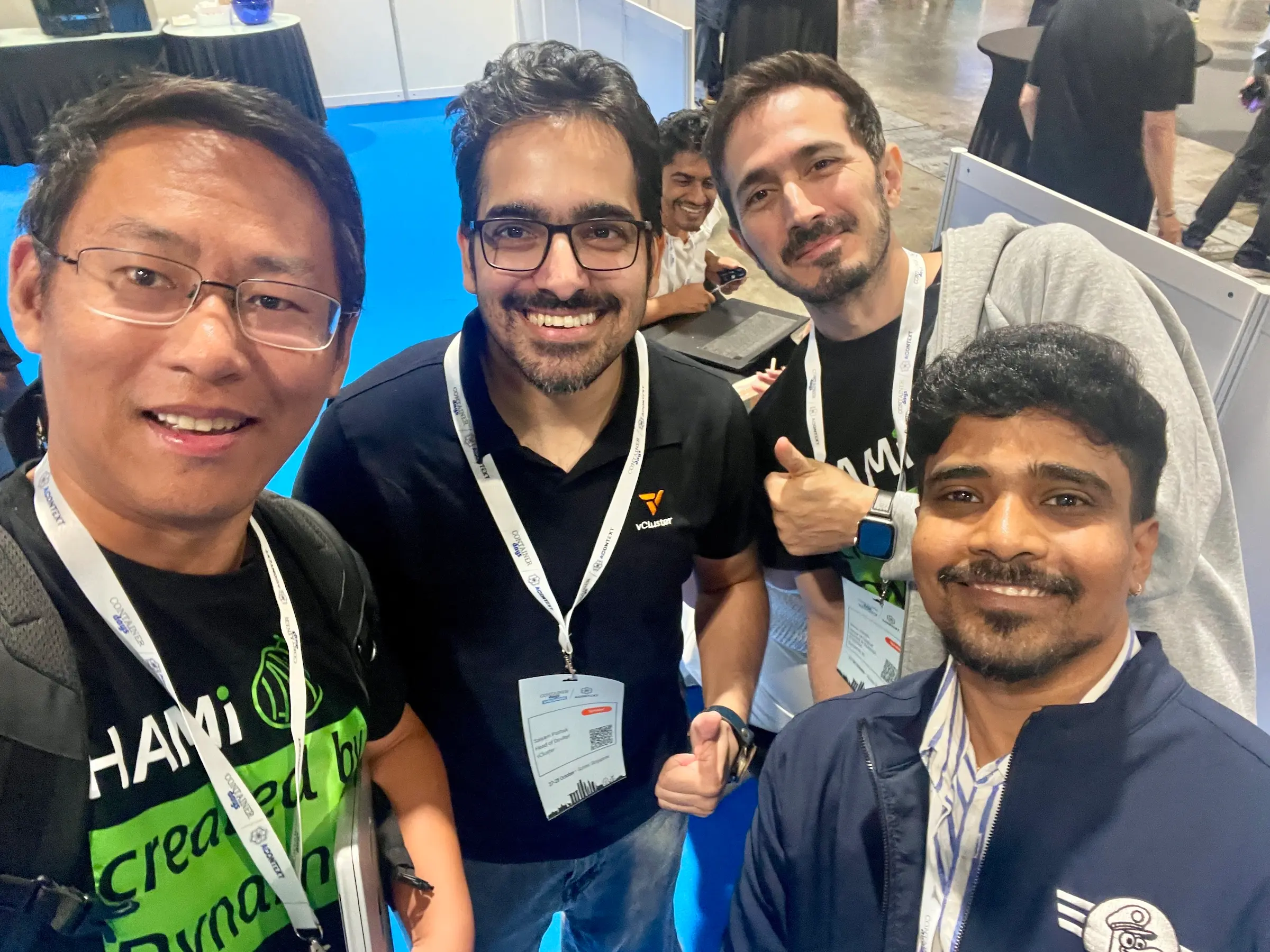
I also caught up with old friends and met new ones, including my colleague Reza Jelveh, Ivan Porta, Saiyam Pathak, Jerry Chen from DaoCloud, Sagar Utekar, Raymond Chong from Singtel, and Dharmjit Singh, plus Yan Wang, who works in blockchain. I also ran into Yang Dongdong, a solutions architect at AWS who had transferred from Beijing to Singapore just a month earlier.
Talking with them gave me a more concrete feel for Singapore’s tech ecosystem. Many Chinese tech companies pick Singapore as their first stop when going global: an international business environment, a relatively mature legal and financial system, and a geographic position that connects to the Southeast Asian market. For engineers, the job market and the international working environment are attractive too.
From these limited conversations, though, my sense is that Singapore’s density of deep infrastructure engineering talent, especially in Platform Engineering, may not match its standing as a regional business hub. It reminded me of Hong Kong: strong commercial connectivity, but not necessarily the place where fundamental technology innovation originates. That is a personal observation from a short trip, not a verdict on the market.
Still, it raises a question worth asking: is a region’s technology ecosystem driven by business opportunity, or by its engineer community?
The two are not in conflict, but they produce different ecosystems. Business opportunities attract companies and capital; sustained technical innovation also needs long-accumulated engineering practice, talent mobility, and a developer community willing to share and collaborate. For Chinese open source companies going global, Singapore may be an excellent commercial starting point, but building real technical influence takes more than that.
Cloud Native Is Going Through a Collective Turn
My strongest impression from the conference was not any single dazzling new technology. It was that the whole cloud native community is searching for a new direction.
Over the past decade, containers, Kubernetes, service mesh, GitOps, and observability gradually matured, and cloud native went from a technical revolution to the default state of modern software infrastructure. That is a success, but success brings its own anxiety: once Kubernetes is just part of the infrastructure, once more and more capabilities are absorbed by cloud providers and managed services, how do the open source projects, startups, and developer communities built on top of those technologies keep proving their value?
AI looks like the obvious answer. Some people are building AI infrastructure, some work on GPU scheduling and utilization, some have moved to agent sandboxes and AI agent runtimes, and some are extending existing Platform Engineering systems to AI workloads.
I do not think this is simple hype-chasing. The deeper reason is that cloud native has solved much of the previous generation’s infrastructure problems, while AI is redefining the application itself.
Traditional cloud native applications usually have a well-defined execution model, lifecycle, and resource model. AI agents do not: they call tools dynamically, execute code, reach external systems, and may need isolated environments, persistent state, and elastic compute. Scheduling, security, isolation, observability, and resource management, the problems we know well, are coming back in new shapes.
Seen this way, cloud native is not obsolete. Much of what it built over the past decade may become the foundation of AI-native infrastructure. But one caution: slapping an AI label on an existing project is not a transformation. What matters is understanding what is genuinely different about the new workloads, and which assumptions in current architectures no longer hold.
Developer Attention Is Moving from Infrastructure to Agents
Another observation from the floor: compared with pure low-level infrastructure topics, sessions that leaned toward AI agent applications and showed working results drew noticeably more attention.
That is easy to understand. For most developers, infrastructure is not the goal; what they can build with it is the real question. When cloud native was growing fastest, we discussed how to deploy applications, manage microservices, and improve delivery efficiency. Now developers care about building agents, letting agents execute tasks safely, and getting these systems into production.
That poses a challenge to the infrastructure community: if we keep telling our story purely in terms of technical components, it gets harder to connect with the broader developer population. The value of infrastructure has to be re-seen through the applications it enables.
This does not mean the underlying technology matters less; it means the narrative has to change. A GPU scheduling system cannot only talk about scheduling algorithms; it has to answer how it lowers the cost of AI workloads. A sandbox project cannot only explain its isolation mechanism; it has to explain why agents need it and how it affects security and developer experience. I suspect the most important connection point between the cloud native and AI communities over the next few years is right here.
Workshop Retrospective: From “It Runs” to “I Understand”
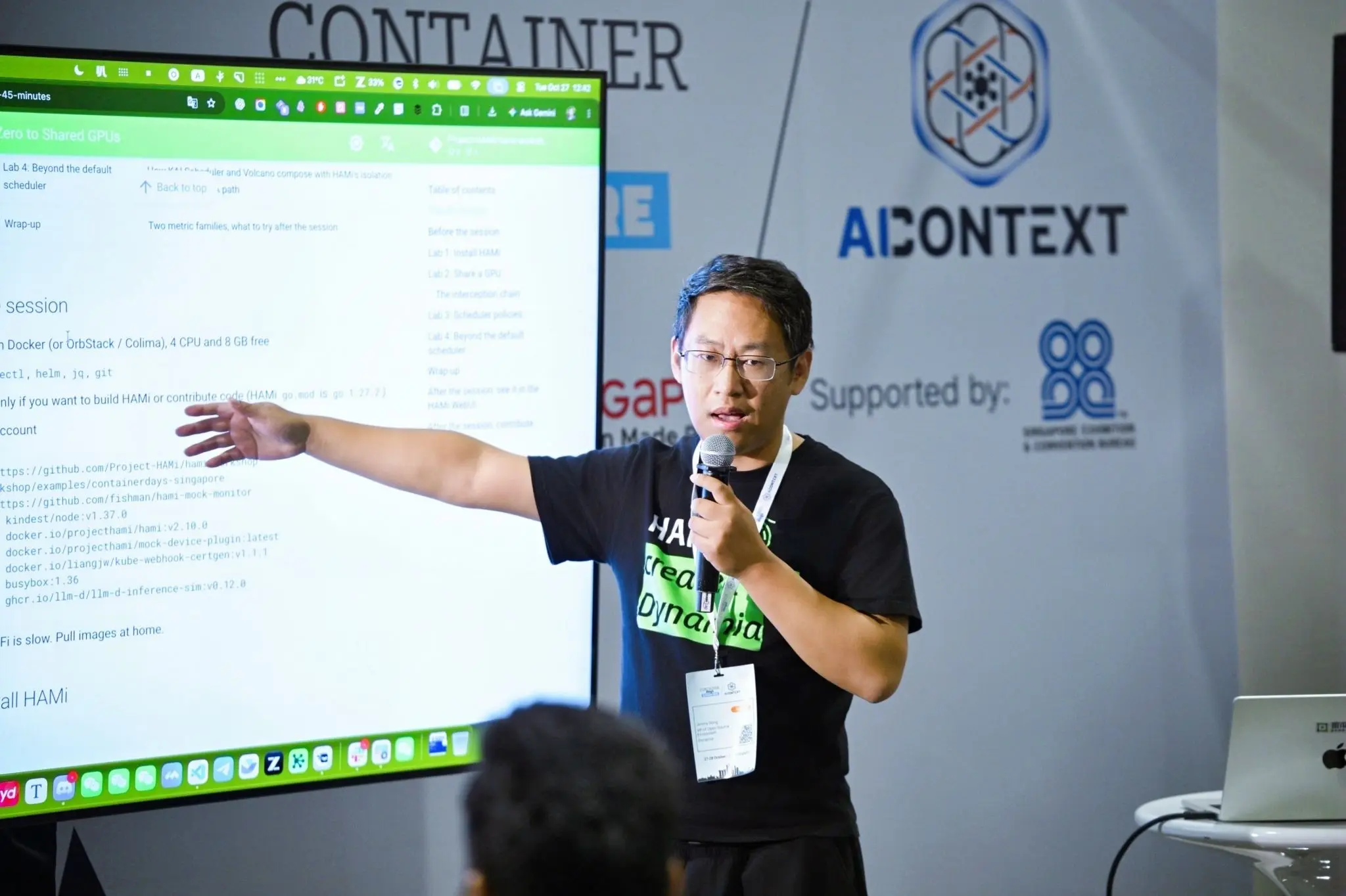
Reza Jelveh and I also ran a hands-on HAMi workshop on GPU sharing and scheduling, done entirely on a local kind cluster with no real GPU required. Quite a few developers interested in GPU resource management showed up, and several participants finished all the labs, which was great to see. But the session also exposed gaps in our preparation.
The biggest problem was the environment. We did not ask participants to register and prepare their setups in advance, so we burned a lot of time installing dependencies on site. The install path was also not sufficiently validated across operating systems, especially Windows.
These problems look trivial, but they define the workshop experience. For the instructor, environment setup is a preliminary step; for the participant, it can decide whether they ever reach the actual technical topic. Next time we should collect participants’ system setups and backgrounds through a form beforehand, send clear preparation instructions, and validate the installation flow per OS, keeping on-site time for labs, discussion, and understanding the mechanics.
It also made me rethink a question in developer advocacy: are we demonstrating how powerful a project is, or helping people actually gain the ability to use it?
There is a long distance between the two. For open source infrastructure projects especially, the quality of documentation, installation experience, examples, and workshops often does more than a brilliant talk to decide whether a developer keeps using the project.
Technology Changes, Human Connections Still Matter
At international conferences, I have always valued the conversations. Talk content can be recovered from recordings, slides, and blog posts, but hallway chats, discussions that unfold over coffee breaks, and catching up with old friends are almost impossible to capture after the fact.
Talking with friends from different companies and countries, you feel how much the underlying concerns have in common: some are figuring out how to keep an open source project sustainable, some are searching for a new product position in the AI era, some are adapting to new markets and jobs, and some keep solving infrastructure problems that never trend but never go away in production.
These conversations remind me that a technology ecosystem is not decided by a trend chart. It is made of specific people, and their choices, collaborations, and long-term commitment. A healthy open source community should not only chase the next hot concept; it also needs room for the people willing to polish foundational technology over the long run.
Next Stop Is Not Just AI
Leaving Singapore, I thought again about the overcast sky I saw on arrival. A city can have efficient infrastructure and an excellent business environment and still not fully control the air around it. Technology ecosystems are the same: the cloud native community cannot stand outside the AI wave, and there is no reason to.
But the question is not only how to connect Kubernetes, GPU scheduling, or sandboxes to AI. It is how to keep building genuinely valuable infrastructure through this new round of change.
Over the past decade, cloud native changed how software is built and run. Over the next decade, AI agents may further change how software executes, and the relationship between people and software. These two shifts are not separate. For those of us who have long worked on cloud native and open source infrastructure, this is a moment to be excited and to stay clear-eyed at the same time.
Technology names will change, hot topics will rotate, communities will reorganize, but the questions that really matter, how to use resources more efficiently, how to build reliable systems, how to reduce complexity for developers, how to drive innovation through open collaboration, have not gone away. Instead of rushing to find cloud native a new label, we should think hard about the irreplaceable value it can offer the next generation of software.
That is probably the deepest impression ContainerDays Singapore left me with.