Attending COSCon'25 in Beijing, I observed firsthand how open source in China is shifting: AI is now the default context, discussions are grounded in real engineering, and the community is embracing long-term thinking. These are not just trends—they are the new reality.
In early December this year, I attended COSCon'25, the China Open Source Annual Conference, in Beijing. Although I have worked in open source for many years, this was my first time participating in an event organized by the Open Source Society—and I joined as a sub-forum producer. Previously, I thought such conferences were too high-level or disconnected from reality, but after actually taking part, I found there was much to gain.
A quick note: this article is not an official conference summary or review. The organizers have already published detailed information about the event’s scale, attendee numbers, and forum sessions. If you’re interested in those details, please refer to the official article: COSCon'25: The 10th China Open Source Annual Conference Successfully Concludes in Beijing—A Comprehensive Recap!
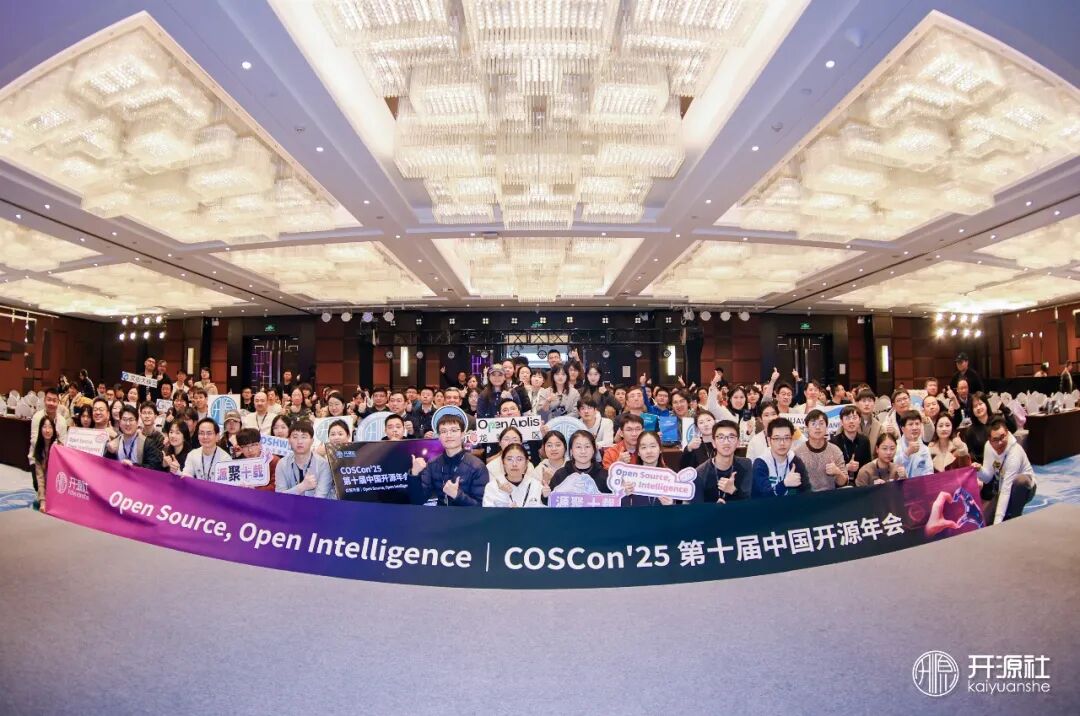
What I want to share is this: Standing on site, on the engineering front lines, and as an organizer rather than an audience member, I saw real changes happening in Chinese open source.
This COSCon: No More Trying to “Prove Open Source Matters”
One clear impression: Almost no one spent time arguing “why do open source” anymore.
In earlier years, common narratives included:
- Is open source safe?
- Can open source be commercialized?
- Can China create its own open source projects?
But at COSCon'25, these questions were basically assumed as “background conditions.” The focus shifted to those already doing open source, and what comes next.
This doesn’t mean the issues have disappeared, but it does mean:
In China’s engineering circles, open source is no longer a “philosophical choice”—it’s a practical way of working.
AI as Background Noise, Not the Main Character
The theme of this year’s conference was Open Source × Open Intelligence, but interestingly, AI did not take center stage.
Instead, it was more like background noise— Almost every topic touched on AI, but no one was giving talks solely “about AI.”
You would see it repeatedly in areas like:
- Cloud native scheduling, focusing on GPU / NPU / heterogeneous resources
- Storage and data, focusing on data paths for training and inference
- Serverless, focusing on LLM cold starts and elasticity
- Observability, focusing on what to do when system complexity gets out of hand
AI was not treated as a “hot trend,” but as a new workload reality. This is a significant change, though not one easily captured in press releases.
Real Impressions as a Cloud Native Sub-forum Producer
I helped organize the cloud native open source sub-forum at this year’s conference. This role gave me a perspective very different from that of a typical attendee.
First, Topics Clearly Converged on “Engineering Problems”
There were almost no talks about Kubernetes concepts; Very few about “architectural philosophies.”
Instead, the focus was on:
- What pitfalls did you encounter at what scale?
- Why did you choose this solution over another?
- Which problems remain unsolved?
Many presentations weren’t “pleasant to hear,” but they were very real.
Second, The Boundary Between Academia and Industry Is Thinning
This was especially evident this year.
Some talks from universities and research institutes were no longer just “from a paper’s perspective,” but directly addressed core issues in industrial systems, such as:
- Cold start of serverless LLMs
- The real value of RDMA in inference paths
- Whether prefill/decode separation is truly feasible in engineering
These topics may not be immediately applicable, but they are now colliding head-on with engineering problems, rather than talking past each other.
Third, Open Source Is No Longer Just About Code
In many discussions, “governance,” “maintenance cost,” and “community collaboration” came up frequently.
This is a signal: When a project is truly being used, code is no longer the hardest part.
Main Forum: More Questions, Not Answers
If I had to sum up the main forum in one sentence: It kept raising questions, but wasn’t in a hurry to provide answers.
For example:
- Has the boundary of open source changed in the AI era?
- Should models, data, and chips become part of the open source core?
- Are developers’ roles being redefined?
There are no standard answers to these questions, but the fact that they are being raised repeatedly shows they have become common concerns, not just the thoughts of a few.
Exhibition Area and Sub-forums: Closer to the Real Ecosystem
Compared to the main forum, I personally paid more attention to the sub-forums and exhibition area.
There, you would see:
- Many projects no longer emphasize “who they want to replace”
- More discussions about “who they can work with”
- Several communities are seriously discussing long-term maintenance, not just releasing versions
This may not be glamorous, but it’s important.
A Personal Judgment
If I had to make a judgment about COSCon'25, I would say:
Chinese open source is shifting from “can we do it” to “can we sustain it for the long term.”
This is a more difficult, but also more realistic, stage.
This COSCon did not try to create a grand narrative. Instead, it felt like a “status exposure” at a particular stage: There are more questions, participants are more diverse, but the discussions are also closer to the real world.
Open source doesn’t depend on a single conference to move forward, but being on site helps you see more clearly: Where exactly are we standing right now?