Goose is not a project that excites you at first glance in this wave of Agent innovation, but its entry into AAIF signals a deeper shift in how we think about Agentic Runtime and AI-Native infrastructure.
At first glance, Goose is not a project that immediately excites people.
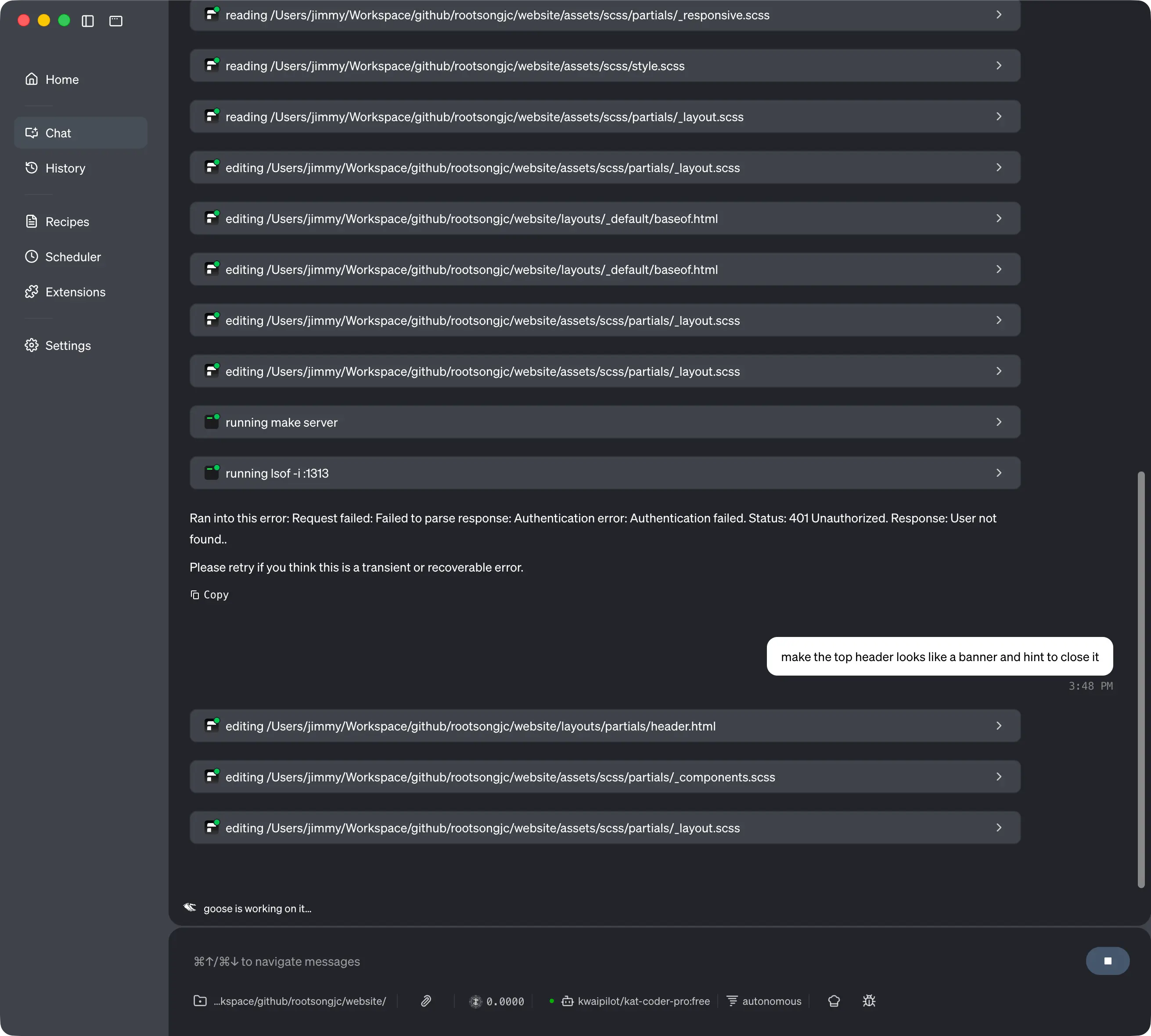
It doesn’t have flashy demos, nor does it showcase overwhelming multimodal capabilities, and it certainly doesn’t look like an AI product aimed at consumers. Yet, this seemingly “plain” project became one of the first donations to the Agentic AI Foundation (AAIF), standing alongside Anthropic’s MCP and OpenAI’s AGENTS.md.
About Goose’s Contributor: Block
Block (formerly Square) was founded in 2009 by Jack Dorsey and has over 10,000 employees and thousands of engineers. Although often categorized as a fintech company, Block has always been driven by engineering and systems capabilities, with a complex tech stack and high automation demands.
In its recent AI transformation, Block focused on automation at the engineering execution layer rather than simply introducing point tools. Goose was born in this context as an internal engineering product, connecting large models with real systems (code, tests, UI, internal tools), and is actually running at scale within the organization. This “born from production” attribute is a key reason Goose became one of the first AAIF projects.
This fact alone is worth a closer look.
This article does not aim to prove how powerful Goose is, but rather to answer three more practical questions:
- What overlooked but long-term critical problems does Goose actually solve?
- Why was it Goose, and not another Agent framework, that entered AAIF?
- What does this mean for Agentic Runtime and AI-Native infrastructure, which I care about?
Goose’s True Positioning: It’s Not an IDE or a Chatbot
If you only look at its surface features, Goose is easily mistaken for one of two things:
- A “multi-model AI desktop client”
- Or an “intelligent programming assistant that can run commands”
But inside Block, it was never designed as a “tool” from the start.
Goose’s origin is closely tied to Block’s engineering environment.
Block (formerly Square) is a classic engineering-driven company: complex systems, high automation needs, many internal tools, and very high execution costs in real production environments. In its recent AI transformation, Block did not focus on “which model to choose” or “which AI tool to introduce,” but directly targeted the engineering execution layer itself.
Goose was born in this context.
Its goal is not to “help people code faster,” but to enable models to stably and controllably take action: run tests, modify code, drive UIs, call internal systems, and operate reliably in real engineering environments.
In short:
Goose is more like an executable Agent Runtime than a conversation-centric product.
Block’s AI Transformation Started with Organization, Not Tools
To understand Goose, you can’t ignore a key organizational shift at Block.
In an interview with Block’s CTO, one signal was very clear: the starting point for AI transformation was not buying tools or stacking models, but the organizational structure itself.
Block shifted from a business-line GM model to a more functionally oriented structure, making engineering and design the company’s core scheduling units again. This is essentially a proactive response to Conway’s Law.
If the organizational structure doesn’t allow technical capabilities to be orchestrated centrally, Agents will ultimately remain “personal assistants” or “engineering toys.”
From this perspective, Goose is not just a tool, but a cultural signal:
Every employee can use AI to build and execute real system behaviors.
This also explains a fact many overlook: Goose was not packaged as SaaS, nor was it rushed to commercialization, but was open-sourced and rapidly standardized.
Because its role inside Block is closer to an “operating system for execution models” than a product that can be sold separately.
Why Did Goose Enter AAIF? Not Because It’s “Technically Strongest”
This is what confuses outsiders the most.
If you only look at flashy features, model support, or community popularity, Goose doesn’t stand out. But AAIF’s choice was not about “maximum capability,” but about whether the position is right.
Looking at the first batch of AAIF projects, a clear chain emerges:
- MCP (Anthropic): Defines how models safely and standardly call tools
- AGENTS.md (OpenAI): Defines behavioral conventions for Agents in code repositories
- Goose (Block): A real, runnable, open-source Agent execution framework
Goose’s role is not to set new protocols, but to serve as the practical carrier and reference implementation for these protocols.
It proves one thing:
- MCP is not just a paper standard
- Agents are not just research concepts
- In real enterprise environments, they can actually run
From this angle, Goose’s “ordinariness” is actually an advantage.
It is not tied to Block’s business moat, nor does it have irreplaceable private APIs; it can be forked, replaced, audited—“boring” enough, and neutral enough.
And that is the most important trait of public infrastructure.
Goose’s Value Lies Not in Today, But in 2–3 Years
From a longer-term perspective, Goose’s value becomes clearer.
What we’re experiencing now is much like the early days of containers: Most Agent projects today are demos, IDE plugins, or workflow wrappers, but what’s really missing is a sustainable, schedulable, observable execution layer.
Goose is already moving in this direction.
Block’s metrics for Goose’s success are straightforward:
- How many human hours are saved each week
- How much non-technical teams reduce their dependence on engineering teams
Behind this is a judgment I’m increasingly convinced of:
What enterprises truly need is not “smarter models,” but “cheaper execution.”
The long-term value of Agents is not in generation quality, but in execution substitution rate.
AAIF Is an Attempt at Infrastructure-Level Consensus
Just as CNCF did for cloud native, AAIF is not guaranteed to succeed.
But it at least marks a shift: Agents are no longer just application-layer innovations, but are beginning to enter the stage of infrastructure-layer collaboration.
As a reference implementation, Goose is likely to remain in this ecosystem for a long time—even if it is replaced, rewritten, or evolved in the future.
Summary
If you see Goose as a “product,” it is indeed not dazzling.
But if you place it in the long-term evolution path of Agentic AI, its significance becomes clear:
It is not the end, but a necessary intermediate state.
For me, the emergence of Goose further confirms one thing:
Agentic Runtime is not a conceptual problem, but an engineering and organizational one.
And that is one of the most worthwhile directions to invest energy in over the next few years.