When renting a GPU starts to feel like reading a hardware review site, the contest moves from “who has the cards” to “who can prove this card is worth the price.”
Not long ago, the hard question about GPUs was whether you could get one at all. That question is fading. The new one is harder: with this many cards, hosts and price points, which one should you rent?
A group of platforms is built around that question. Vast.ai, Runpod and TensorDock turn compute into something you can comparison-shop. In China, qlsoulmate.com (器灵算力站) pushes the idea further. Its front page reads like a gadget review site: new hardware, measured results, a hardware ranking, a most-rented list and a wall of chip brands.
A disclosure first. I have been involved in the HAMi community for a long time, so I look at slicing and scheduling from that layer. I have no commercial relationship with any platform mentioned here, and every number comes from their public pages and docs as of November 2026. There is also a slide version of this post.
Two Ways to Buy Compute
Traditional clouds sell shapes. You pick an instance type, commit or pay on demand, and the provider sets the price and backs the SLA. You get the resource first and work out how to use it well afterwards.
Marketplaces flip the order. Vast.ai’s docs define it as a marketplace connecting hosts and renters, where a host can be anyone from an individual with one gaming PC to a Tier 4 datacenter. Its pricing page is blunt: no static price quotes, rates follow real-time supply and demand, billing is by the second.
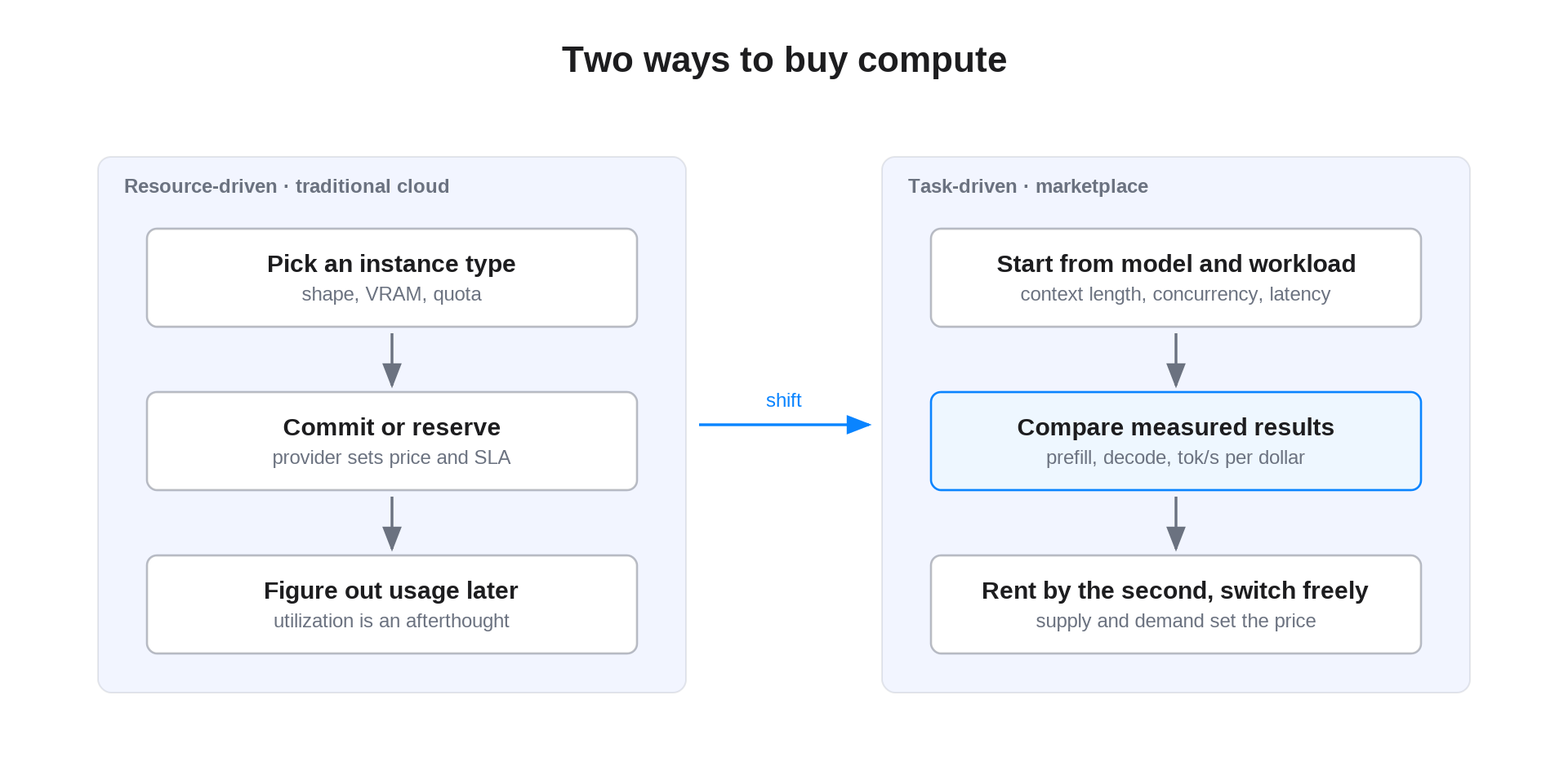
Traditional clouds sell certainty. Marketplaces sell choice.
Choice has a price. Vast.ai’s interruptible instances run on bidding, and the docs say plainly that your instance is paused when someone outbids you. New machines start at a 60% reliability score and earn the rest. Runpod’s selection guide carries a one-line note that Community Cloud no longer accepts new hosts. It gives no reason and I will not guess one. But balancing open supply against controlled quality is clearly not easy.
Why Leaderboards Appear
Because the same model name does not mean the same result.
Two listings can both say “RTX 4090 24GB” and differ in CPU, RAM, disk, network and cooling. A spec sheet cannot tell you whether this particular machine is any good.
So Vast.ai attaches a DLPerf score to every offer, described as a way to compare offers instead of relying on raw specs. It also ships vastai run benchmarks: rent one instance of each GPU class, run the same workload, and print a table sorted by performance per dollar per hour. The docs add a caveat I appreciate: the score ranks GPUs on one template and is not meant for comparison across templates.
SemiAnalysis’s InferenceMAX asks the same question at datacenter scale: how many tokens per dollar and per megawatt.
qlsoulmate shows where the consumer end of this may go. It treats inference measurements as content. Its front page lists numbers such as 52.8 tok/s single-stream decode across four machines at TP4 (DeepSeek-V4-Flash), and 231 seconds for a cold 300K-token prefill. Its test page lets you submit an OpenAI-compatible endpoint and sweeps the prompt from 4K to 1024K tokens.
Two caveats. The site labels its tok/s-per-yuan ranking, side-by-side tests and rent-or-buy calculator as “phase two”, so they are a roadmap today. Many hardware specs on the page are marked as pending verification. Treat these numbers as one vendor’s own measurements, not an industry baseline.
A leaderboard turns “selling cards” into “selling proof.”
Why Spec Sheets Mislead
Sizing guides usually stop at memory. Runpod’s guide, for instance, suggests about 2 GB of VRAM per billion parameters. That tells you whether a model fits. It does not tell you how fast it runs, because the two phases of inference hit different limits.
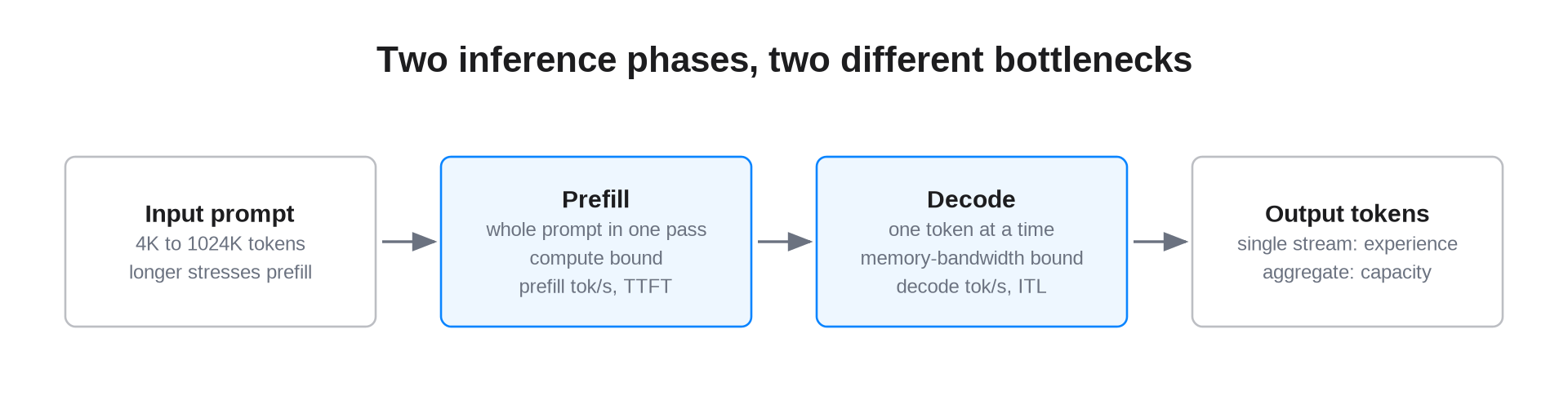
Prefill processes the whole prompt in one pass and leans on compute. Decode emits one token at a time, touching the weights and the KV cache at every step, and leans on memory bandwidth.
A cold 300K-token prefill that takes 231 seconds means almost four minutes before the first token. For long-document analysis or a coding agent over a whole repository, no decode speed rescues that. For short chat the picture reverses and prefill barely matters.
One term is often mixed up here. MFU is Model FLOPs Utilization, mostly a training metric, and it is not memory-bandwidth utilization. I laid out how these metrics stack up in From GPU to Token.
Now the money. The numbers below are hypothetical and only illustrate the arithmetic.
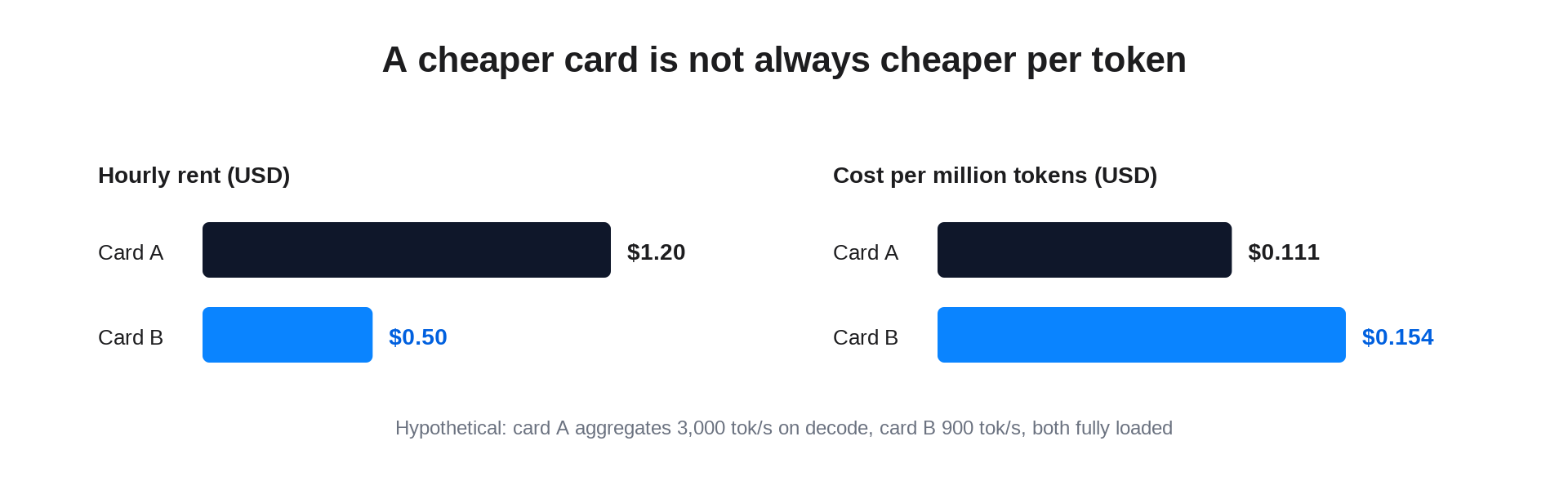
Card B rents for less than half the price and still costs almost 40% more per token. Comparing by the hour compares rent. Comparing by the token compares cost.
The metric has a blind spot: it assumes the machine is always fully loaded. Real workloads rarely are, and idle time is billed all the same. That brings the problem back to slicing and scheduling.
Beyond NVIDIA
The selection guides I cited list NVIDIA cards. Vast.ai’s default benchmark set is RTX 5090, 4090, 3090 and A6000, and Runpod’s workload table names RTX 4090, L4, A100, H100 and RTX PRO 6000. qlsoulmate’s brand wall is wider: NVIDIA and AMD next to Huawei Ascend, Hygon, Cambricon, Moore Threads, Biren and MetaX.
Being listed and being usable are different things. I have no first-hand benchmark data across these chips, so I will not rank them. The structural problems are visible from the software side.
- The stacks differ. CUDA, ROCm and Huawei’s CANN are separate worlds. vLLM supports Ascend through a separate plugin project, vllm-ascend.
- Version combinations are brittle. HAMi’s Ascend guide says its hami-core mode currently supports ARM platforms only and needs driver 25.5 or later, and the ENPU mode has a CANN and HDK compatibility table per chip.
- Public measurements are thin. For accelerators outside the NVIDIA line, reproducible prefill and decode numbers on mainstream open models are hard to find.
Slicing is uneven too. The table is an excerpt from the HAMi v2.11.0 device matrix.
| Device | Slicing mode | Memory control | Compute control |
|---|---|---|---|
| AMD GPU (Instinct / ROCm) | CU slicing | Memory quota | CU share |
| AWS Neuron (Inferentia / Trainium) | Whole device or core allocation | No separate quota interface | NeuronCore allocation |
| Huawei Ascend NPU | template, hami-core, ENPU | Template or quota | Template, quota or ENPU policy |
| Hygon HCU | Dynamic vHCU | Memory quota | Compute share |
| Cambricon MLU | Dynamic SMLU | Memory quota | Core quota |
Every vendor brings its own mechanism, granularity and isolation semantics. Half an Instinct and half an Ascend are not the same product, and they are hard to sell under one price list.
In your own cluster, adaptation is an operations cost. On a marketplace, it is a support ticket that says “I rented it and it will not run.”
After Matching Comes Slicing
Matching solves “find a card.” It does not solve “the card is too big.”
A Vast.ai instance gets exclusive access to the GPUs it rents. A quantized 7B model does not fill a 48 GB card, yet the renter pays for all of it.
Runpod already sells slices: MIG slices of the RTX PRO 6000 at 24 GB and 48 GB, on Secure Cloud only. MIG rather than soft slicing, Secure Cloud rather than community hosts. Those two conditions are the answer in themselves: a slice sold to outsiders needs hard isolation and a host you control.
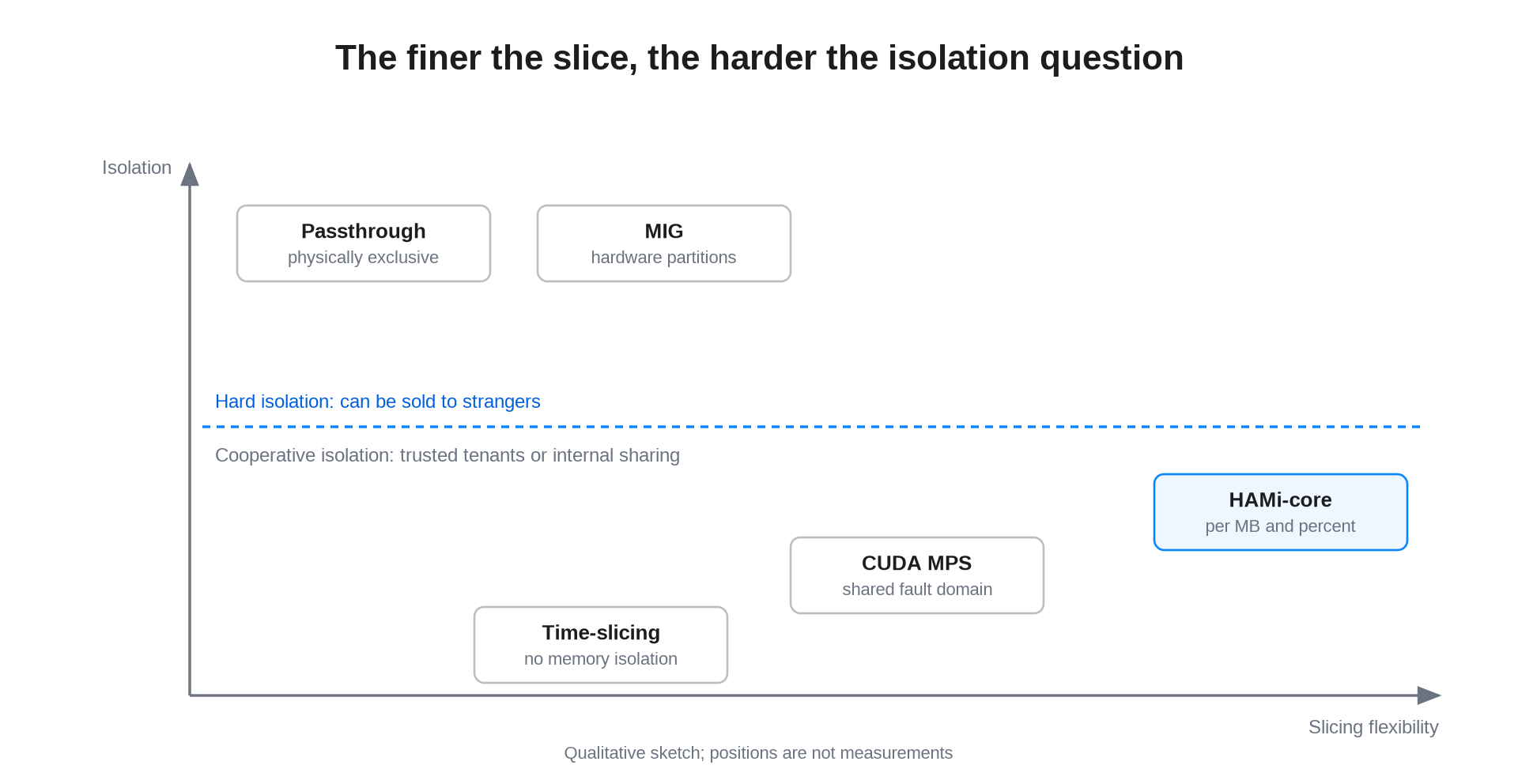
NVIDIA’s documentation is candid about time-slicing: no memory isolation and no fault isolation between replicas. Selling that as “a quarter of a card” sells the noisy neighbor along with it.
HAMi-core intercepts CUDA calls inside the container, caps memory by the megabyte and throttles compute by time slice, and it does not require MIG support. That matters on marketplaces, where consumer cards without MIG are common.
The boundary needs stating as well. API interception is cooperative. It fits trusted tenants or platform-managed images. When tenants are fully untrusted, add MIG, a virtual machine or a sandboxed container on top.
The trade-off between granularity and isolation decides what a card can be sold as.
Four Layers
Put together, the stack behind a compute marketplace has roughly four layers.
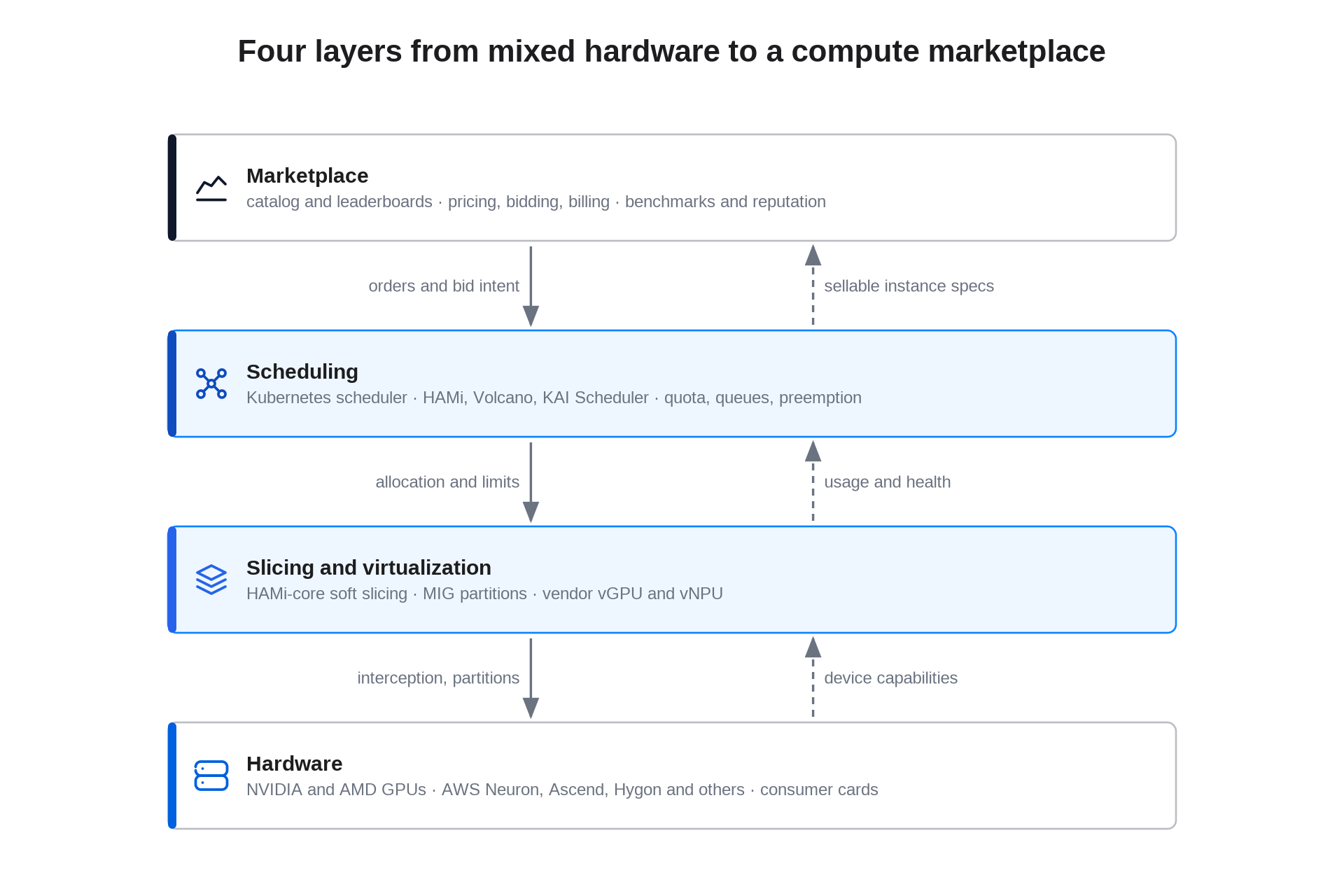
The top layer is the loud one, with the traffic, the rankings and the transactions. I think the margin is decided in the middle two.
Sold whole, a card serves one tenant. Cut into four slices that all sell, the same hardware earns on a different scale. Cutting is the virtualization layer’s job. Filling the slices, not overselling them and moving workloads when something breaks is the scheduler’s job. I argued for the long-term value of partitioning in Models Keep Getting Bigger. Why Do We Still Need GPU Partitioning?, and a marketplace is where that value turns into revenue most directly.
Mixed hardware raises the stakes. HAMi v2.11.0 already lists more than a dozen device types behind one scheduling entry point, which gives a platform a ready-made adaptation layer.
HAMi is not the only answer. After NVIDIA acquired Run:ai, its scheduler was open sourced as KAI Scheduler, and Volcano has its own vGPU path. According to HAMi’s docs, both keep their own scheduling and reuse HAMi-core for runtime isolation.
Schedulers stay plural. The data plane is converging.
The Missing Interfaces
Will a standard interface emerge between schedulers and compute markets? I think so, but it is far off. I see three gaps.
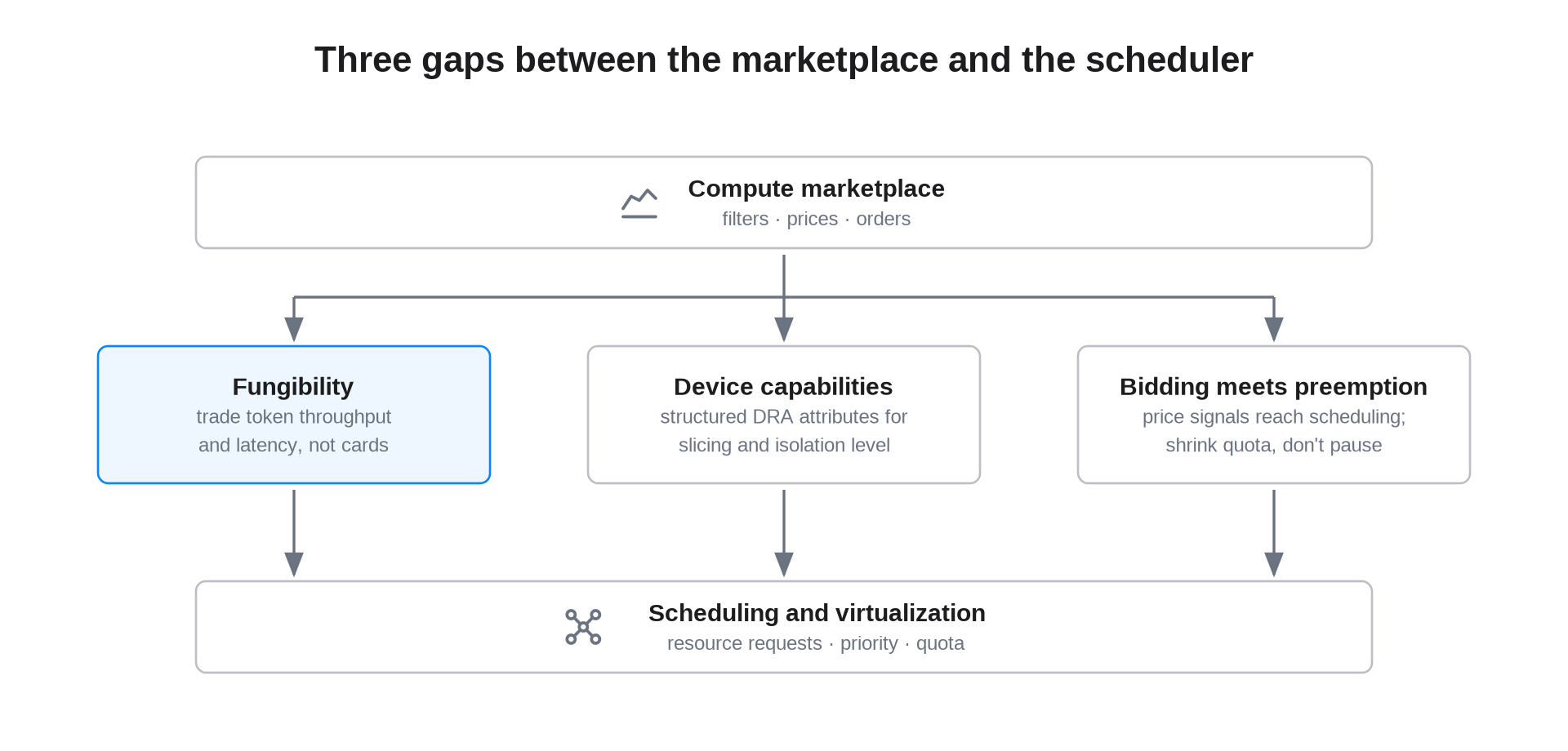
Fungibility. Electricity trades because a kilowatt-hour is a kilowatt-hour. Half an A100 and half an Ascend 910B do not swap. A workable direction is to change the unit from “a card” to “token throughput and latency for a given model and context length.” That is what leaderboards already do, each with its own methodology. More background in Token Is More Than a Billing Unit.
Device capability claims. Kubernetes DRA (Dynamic Resource Allocation) lets a device describe itself with structured attributes. If slicing mode, isolation level and measured throughput became attributes, a marketplace filter and a scheduler request could speak the same language. I have not seen a mature practice that maps market semantics this way.
Bidding meets preemption. Vast.ai’s bidding works at the instance level. If the price signal reached the scheduler, a low bid could have its quota squeezed instead of being paused outright. Only then does bidding on slices become real.
None of the three is purely technical. Who defines the methodology, who audits the data and who is liable in a dispute all need agreement across the industry.
Summary
GPU scarcity is shifting from “cannot get one” to “cannot choose one.”
- Traditional clouds sell certainty and marketplaces sell choice, at the cost of uneven supply.
- Leaderboards answer an information gap. Prefill, decode, tail latency and tokens per dollar sit closer to real cost than TFLOPS, as long as the methodology is public.
- Accelerators outside the NVIDIA line are held back mostly by software stacks, version matrices and the lack of public measurements.
- Matching is the front end. Whether a card can be safely cut up, sold out and metered depends on the slicing and scheduling layers.
- Standard interfaces are early. Fungibility, device capability claims and a bridge between bidding and preemption are the three I would watch.
Leaderboards will multiply, but a leaderboard produces no compute. What turns each rental dollar into more tokens is the less visible infrastructure underneath.
References
- Concepts - docs.vast.ai
- Pricing - docs.vast.ai
- Instance Types - docs.vast.ai
- Choosing GPUs for Your Workload - docs.vast.ai
- Choose a Pod - docs.runpod.io
- qlsoulmate.com (器灵算力站) - qlsoulmate.com
- Devices supported by HAMi - project-hami.io
- Time-Slicing GPUs in Kubernetes - docs.nvidia.com
- Dynamic Resource Allocation - kubernetes.io
- InferenceMAX: Open Source Inference Benchmarking - inferencex.semianalysis.com