AI is quietly reshaping the infrastructure landscape, and GTC 2026 may become a key node in this transformation.
Next week, one of the most important technology conferences in the AI industry, NVIDIA GTC 2026, will be held in San Jose, USA.
For many people, GTC is just a GPU technology conference. But if you follow the development of the AI industry over the past few years, you’ll find an interesting phenomenon:
Many important narratives about AI infrastructure are gradually taking shape at GTC.
From CUDA, DGX, to AI Factory, and most recently Jensen Huang’s proposed AI Five-Layer Cake, NVIDIA is constantly attempting to redefine the computing infrastructure of the AI era.
This is why many people call GTC:
AI’s “Woodstock.”

This year’s GTC (March 16-19) is expected to cover various levels of the AI stack, including:
- AI Chips
- AI Data Centers
- AI Agents
- Robotics
- Inference Computing
According to NVIDIA’s official blog, this year’s keynote will focus on the complete AI stack from chips to applications.
If we put these signals together, we can actually see a larger trend:
AI is transforming from an “applied technology” into “infrastructure.”
The Perspective of Industrial Revolutions
From a longer time scale, the technological revolutions in human history are essentially infrastructure revolutions.
We usually divide industrial revolutions into four times.
In the table below, you can see the infrastructure corresponding to each industrial revolution:
| Industrial Revolution | Infrastructure |
|---|---|
| Steam Revolution | Steam Engine |
| Electrical Revolution | Power Grid |
| Digital Revolution | Computer |
| Internet Era | Network |
First Industrial Revolution: Steam
The steam engine allowed humans to utilize mechanical power on a large scale for the first time. Production no longer relied on human or animal power, but on machines.
Second Industrial Revolution: Electricity
Electricity changed not only the source of power, but also the organization of production. Assembly lines, large-scale manufacturing, and modern industrial systems are all built on the foundation of the power grid.
Third Industrial Revolution: Computers
Computers allowed information to be processed digitally. Software became a production tool.
Fourth Industrial Revolution: Internet and Intelligence
The internet connects all computers together. Cloud computing transforms computing resources into infrastructure. And AI gives machines a certain degree of “cognitive ability.”
The True Significance of AI
If we observe these industrial revolutions, we discover a pattern:
Each industrial revolution produces a new General Purpose Infrastructure.
And AI is likely to become the next-generation infrastructure.
NVIDIA even directly stated in a recent article:
AI is essential infrastructure, like electricity and the internet.
In other words:
AI is no longer just an applied technology, but a new factor of production.
NVIDIA’s Five-Layer Cake
Recently, Jensen Huang proposed a very interesting concept: AI Five-Layer Cake.

AI is broken down into five layers:
- Energy
- Chips
- AI Infrastructure
- Models
- Applications
This model actually illustrates one thing:
AI is a complete industrial system.
Jensen Huang even described AI at Davos as:
“One of the largest-scale infrastructure constructions in human history.”
Signals GTC 2026 May Release
This year’s GTC is expected to release several important directions.
Inference Computing
The focus of AI in the past was training. But the main load of AI in the future is likely to be Inference.
Analysts expect that by 2030, 75% of computing demand in the AI data center market will come from inference.
Agentic AI
The past AI model was:
User → Model → Answer
The Agent model is more complex:
User → Agent → Tools → Model → Action
The flowchart below shows the main interaction paths in the Agent model:
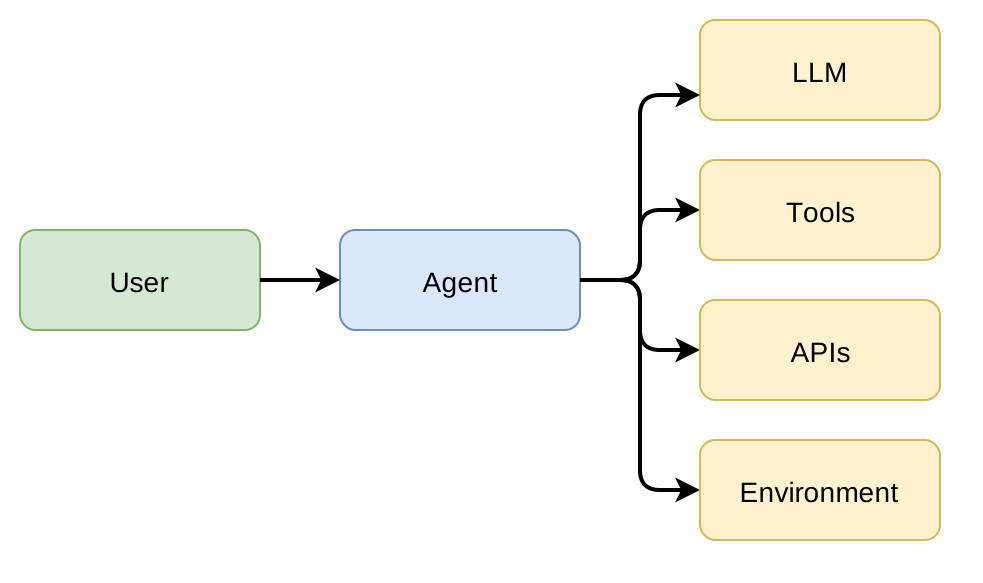
AI is no longer just answering questions, but executing tasks.
Agent Platform
Recent media reports suggest that NVIDIA may launch a new Agent platform: NemoClaw, aimed at helping enterprises deploy AI Agents.
If this project is truly released, it means NVIDIA’s stack will become the following structure:
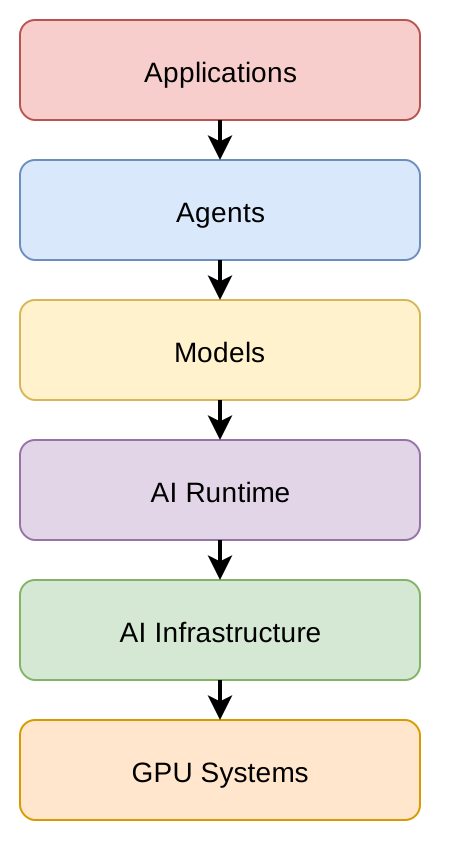
This is actually a complete AI stack.
Agents Change Computing Workloads
The emergence of Agents brings new computing workload issues.
Past AI workloads were mainly:
- Training
- Inference
But Agents bring a third type of workload:
Agent Workloads
The figure below shows the diverse workload types related to Agents:
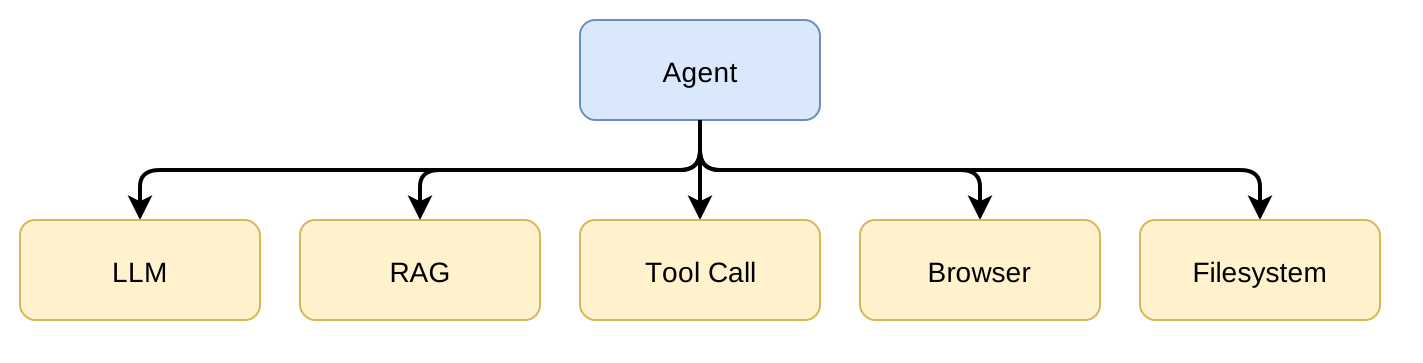
The characteristic of this workload is highly fragmented. GPUs are no longer occupied for long periods, but rather face many small requests. This poses new challenges for infrastructure.
AI-Native Infrastructure
For the past few years, I’ve been thinking about a question:
What is AI-native infrastructure?
It is clearly not just “Kubernetes with GPUs.” I’m more inclined to believe it needs to possess several characteristics.
GPU as a First-Class Resource
In the cloud computing era, CPU is the core resource. In the AI era, GPU is the core resource.
Heterogeneous Computing
Real-world AI chips are not limited to NVIDIA:
- NVIDIA
- Ascend
- Cambricon
- Metax
- Moore Threads
Future AI infrastructure must be able to manage heterogeneous computing.
GPU Sharing
GPU is a very expensive resource. If it cannot be shared, utilization will be very low. This is why GPU virtualization and slicing are becoming increasingly important.
AI Scheduling
AI scheduling includes not only traditional CPU and Memory, but also:
GPU
VRAM
Topology
Bandwidth
A Possible AI Tech Stack
Combining the above trends, the future AI stack may present the following structure:
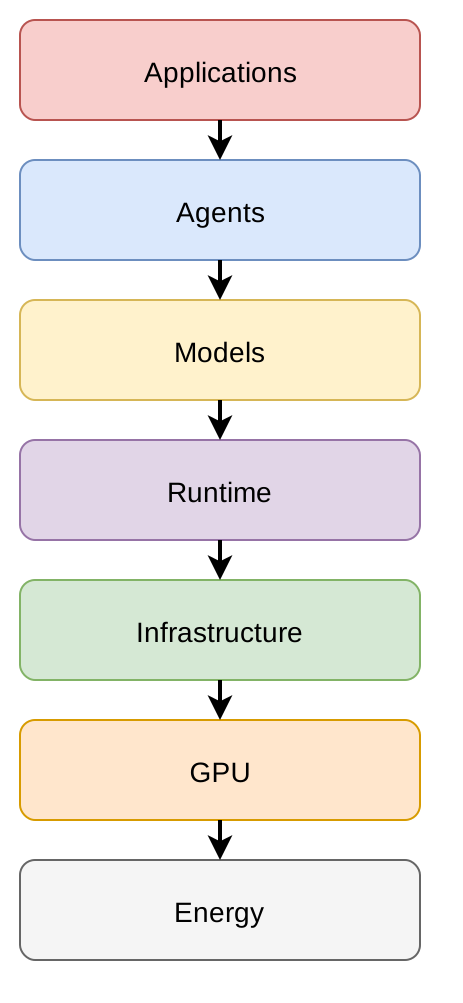
This structure is very close to NVIDIA’s Five-Layer Cake.
My Judgment
Combining signals from GTC, AI Factory, Agents, and AI Five-Layer Cake, we can see a very obvious trend:
AI is rewriting computing infrastructure.
Future competition may not just be “who has the best model,” but:
Who has the best AI Infrastructure.
Just like the past few decades:
- Electricity determines industrial capability
- Internet determines information capability
- Cloud computing determines software capability
The future may be:
AI Infrastructure determines intelligence capability.
Summary
If we stretch the time scale a bit longer, we may be in a new historical stage.
AI is no longer just a technological tool. It is becoming new infrastructure.
Just like:
- Electricity
- Internet
- Cloud computing
And AI-native infrastructure is likely to become one of the most important technology directions for the next decade.