After HAMi became a CNCF Incubating project, I want to talk about something overlooked: AI is shifting the scarce resource of open source communities from code to consensus.
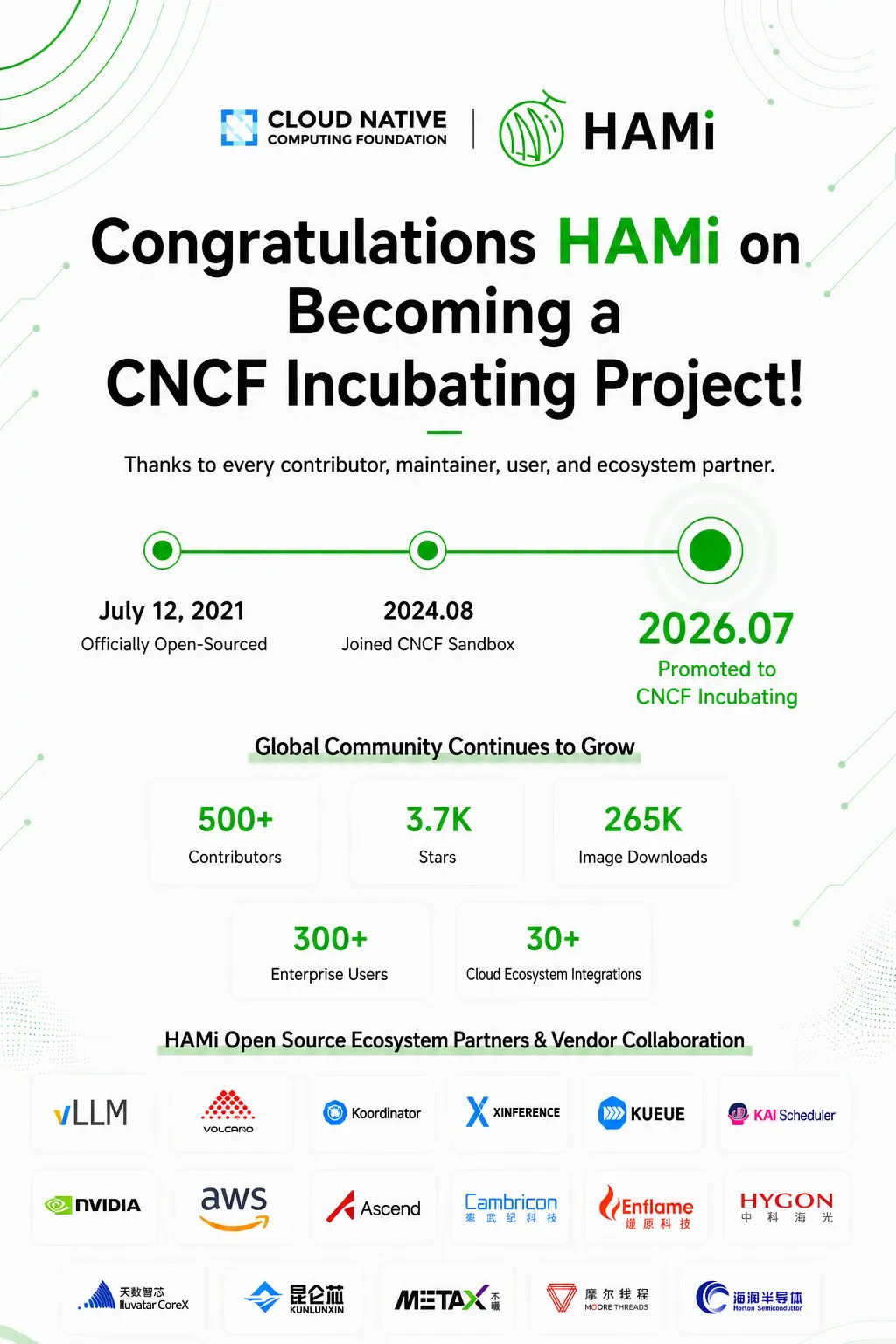
On July 2, 2026, HAMi officially became a CNCF Incubating project (see the announcement). For an open source project, this means more than recognition of its technical capability; it means that community governance, ecosystem building, and real-world adoption have all entered a new phase.
But if you only read HAMi’s growth as “a GPU virtualization project succeeded,” you might miss the more important shift.
My time building the HAMi community has left me with one increasingly strong feeling: AI is changing how open source communities produce. As AI coding drives the cost of producing code lower and lower, the core of competition in open source will no longer be who wrote the most code, but who can build stronger technical consensus, attract more contributors, and form a sustainable ecosystem network.
This article is my attempt to lay out that argument clearly.
HAMi’s Growth Shows That a Project’s Real Asset Is Its Community
Let’s start with the data. Here is where HAMi stands today:
| Metric | Value |
|---|---|
| GitHub Stars | 3,700+ |
| Contributors | Nearly 500, from 27 countries |
| Participating organizations | Multiple, and growing |
| Release cadence | Once every three months |
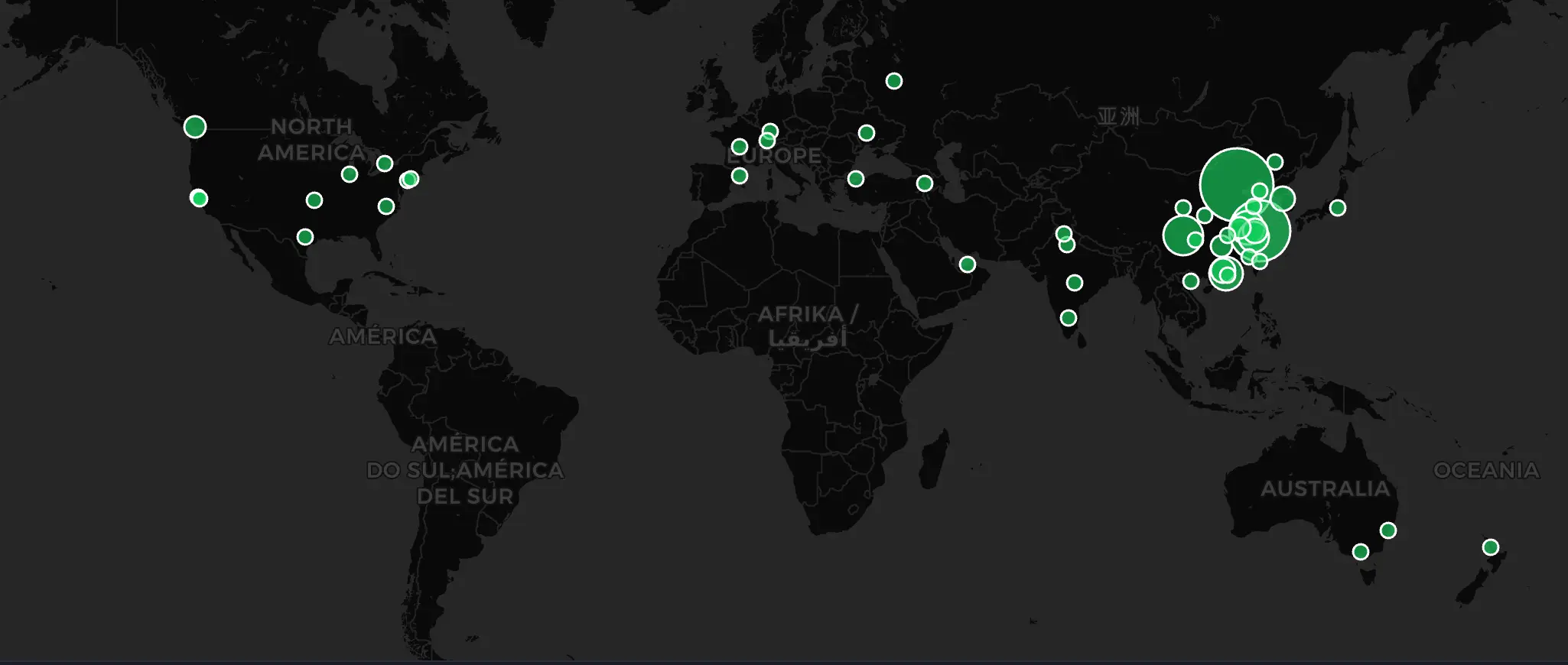
I’m not listing these numbers to show off “growth metrics.” I’m making a different point: an open source project is shifting from “software maintained by a team” into “a technical community of people gathered around a shared goal.”
That distinction matters. Software can be forked, rewritten, or generated overnight by AI. But a community with a shared goal, trust, and rhythm cannot be forked. That is the irreplaceable asset of an open source project.
From a governance-maturity perspective, HAMi has passed through three milestones:

Note the middle stretch: from entering Sandbox in August 2024 to reaching Incubating in July 2026, roughly two years. During those two years the code certainly grew, but what actually convinced the CNCF Technical Oversight Committee (TOC) was the diversification of the community, the formalization of governance, and real production adoption. None of that is something you produce by writing code.
When HAMi Open-Sourced in 2021, There Was No AI Coding
HAMi was first open-sourced in 2021. Back then, most developers did not see AI coding the way we do today. Whether an open source project survived depended on developers genuinely investing their time, discussing problems in issues, submitting code through pull requests, and building trust through code review.
Today, the environment has changed.
In a recent HAMi community livestream (Mastering HAMi DRA, Yang Shouren, HAMi Community Livestream Episode 2), someone asked the maintainers a question: “How much of HAMi’s code now comes from AI assistance?”
The answer from Yang Shouren stuck with me: about half of the code in the HAMi community today is already AI-assisted.
Half. And that share is still rising.
This immediately raises a sharp question: if AI can write more and more code, what is the value of an open source community? Could one person plus a few AI agents just fork a “new HAMi”?
My answer is no, because what AI lowers is the cost of producing code, not the cost of building technical consensus.
In the AI Era, Code Is No Longer Scarce; Consensus Is
Let me sharpen that point.
An AI agent can already do a lot today: write code, fix bugs, add tests, generate docs, produce migration scripts. These capabilities are getting stronger fast. But there are a few things in a community that AI cannot replace today, and in my judgment will not replace soon.
First, deciding which problems are worth solving.
Take HAMi. Why does GPU sharing matter? Not because “slicing cards finely” is a cool technique. It matters because once AI infrastructure scales, reality looks like this: GPU costs are enormous, heterogeneous hardware keeps multiplying, and Kubernetes’ native resource model is no longer enough.
The community has to first agree that “this problem is worth investing in” before anyone writes any code. That agreement is a human-to-human matter, supported by real scenarios, real costs, and real pain. AI can solve a problem you have already defined, but “which problem is worth defining” is decided by community consensus.
Second, choosing a technical path.
In GPU virtualization there are many paths: MIG, MPS, time-slicing, vGPU, DRA. Each has trade-offs, and choosing wrong can cost you two years of detours.
Code can be generated, but architectural choice is fundamentally a value judgment. HAMi’s decision on Ascend 910C to move from hardware SR-IOV to userspace HAMi-core was not about someone writing a better piece of code; it was about the maintainers holding to a judgment that “hardware partitioning is too coarse, software partitioning is more flexible.” That kind of judgment is ground out through repeated discussion, failure, and validation in the community, not prompted out.
Third, trust.
Users don’t choose HAMi because of “how much AI-generated code is in this repo.” They care about: who maintains it? Who reviews it? Are there real production cases? Does the community respond when something breaks?
Each of these is a relationship between people, a product of community organization, not a product of code quality.
Put these three together, and the production model of open source communities in the AI era is shifting:

In the past, code came first and the community sedimented out of the code; in the future, consensus comes first, AI rapidly turns consensus into code, and code flows back to test the consensus. The center of gravity of the scarce resource moves from “code” on the left to “consensus” on the right.
In the AI Era, Open Source Governance Itself Has to Level Up
Since AI has become a new category of contributor, a community’s governance rules have to keep up.
My advice is: don’t treat AI merely as a tool, treat it as a new type of contributor. It used to be “developers write code, humans review”; in the future it will be “humans set intent, AI generates code, the community reviews, and shared knowledge is distilled.” There is an extra layer in the middle, and an extra layer of governance complexity.
HAMi is already responding to this. Its CONTRIBUTING.md is explicit:
If you are using any kind of AI assistance to contribute to HAMi, it must be disclosed in the pull request.
In other words, if you use AI to help with a contribution, you must declare it in the PR. But the community also knows that a norm without a gate is not enough (see the discussion in Issue #1998), and there is already ongoing discussion about how to give that norm real enforcement.
This is actually a problem every AI-era open source project will run into. I’d break it into a few questions:
- Must AI-generated code always be declared?
- Which model, and what context, did the contributor use?
- How do you ensure the security of AI code, avoiding injection and licensing risks?
- What process should maintainers use to review an AI diff they may not be able to fully trace themselves?
Whoever figures out and operationalizes these rules first will keep contribution quality stable in the AI era. HAMi’s exploration here is worth a look for every open source project.
What CNCF Incubating Really Means
Back to the promotion itself.
I’d lean against treating it as an “honor.” What CNCF Incubating really validates is not code quality, but whether a project has the capacity to become infrastructure. It examines a whole package: technical maturity, community governance, production adoption, and ecosystem building.
HAMi’s case, in one sentence, is not “a Chinese team built a GPU project.” It is this:
An AI Infrastructure community, jointly shaped by developers from around the world, is taking shape.
The first is a product story; the second is an ecosystem story. The Incubating recognition from the CNCF is recognizing the latter, because competition over infrastructure is never competition between individual products; it is competition between ecosystem networks.
Summary
The open source competition of the next decade will not be just a competition of code, but a competition of communities.
Once AI gives everyone near-infinite capacity to produce code, the truly scarce capabilities will be three: finding the right problem, building technical consensus, and organizing developers worldwide to solve a problem together.
HAMi’s path to CNCF Incubating is just one snapshot of how open source communities are evolving in the AI era. Code will keep getting cheaper, and consensus will keep getting more expensive. Whoever understands this inversion will be the one who can build open source communities with real depth in the AI era.
Join the HAMi Community
Add me on WeChat (
jimmysong) or follow HAMi on GitHub to join the community focused on GPU virtualization and heterogeneous compute scheduling. Let’s talk about open source governance in the AI era.