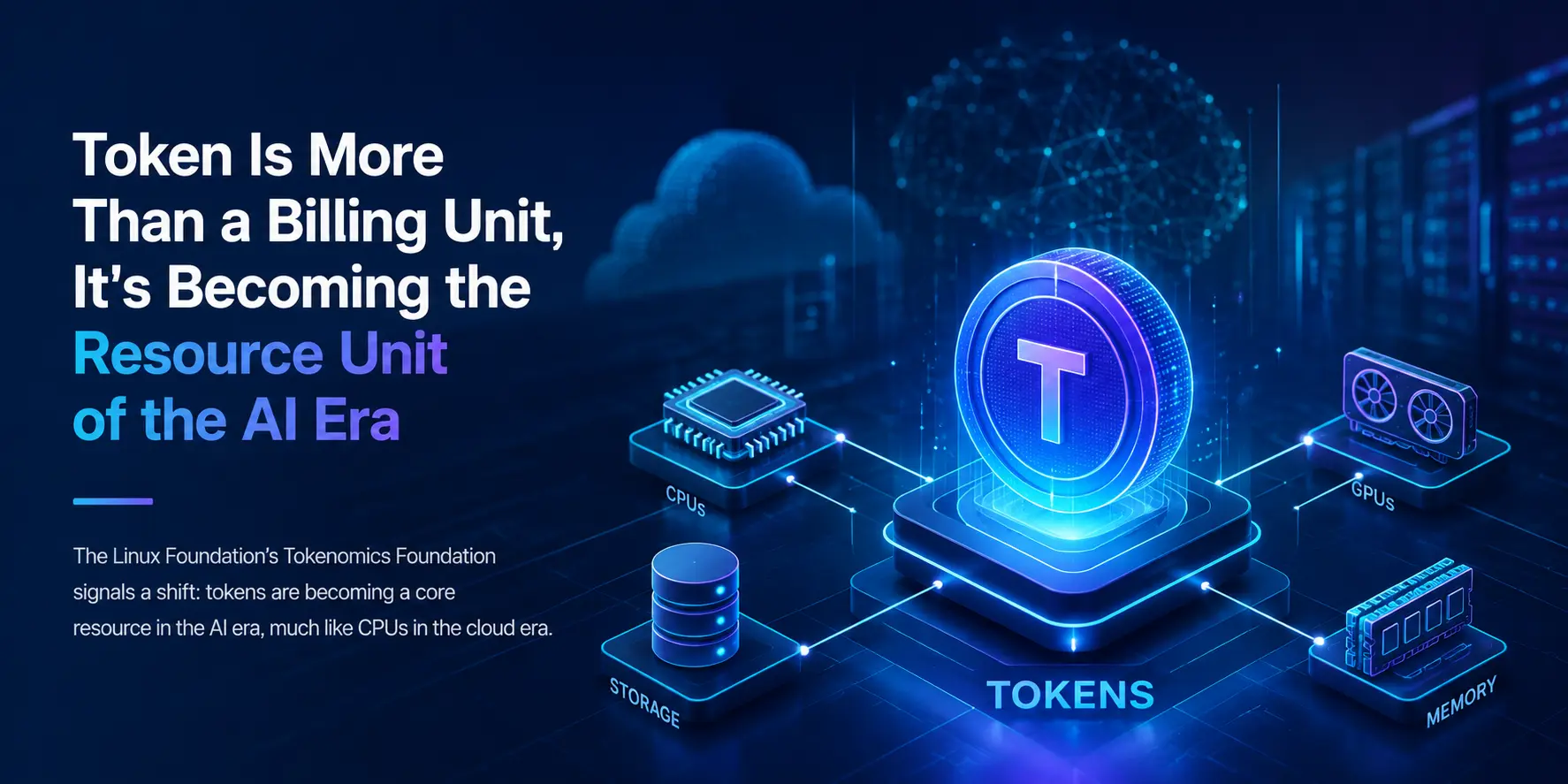
The Linux Foundation recently announced plans to establish the Tokenomics Foundation.
When I first saw the news, my immediate reaction wasn’t:
Yet another foundation.
It was:
AI infrastructure is shifting from “managing GPUs” to “managing Tokens.”
That shift may matter more than the foundation itself.
The official rationale from the Linux Foundation is straightforward:
As enterprises begin deploying generative AI and agents at scale, the Token has become the new unit of technology spend. The foundation will partner with the FinOps Foundation to establish Token cost management, benchmarks, open standards, and best practices.
If you stop there, most people would reduce it to:
FinOps for AIOr:
AI cost managementBut I think there’s more to it than that.
The Cloud Era Managed Resources
For the past two decades, the infrastructure industry has been managing resources.
We discussed:
- CPU
- Memory
- Storage
- Network
- GPU
Kubernetes was no different.
Whether it was the scheduler, autoscaling, or resource quotas, everything fundamentally answered one question:
How do we allocate resources?That was the central question of the cloud era.
The AI Era Starts Managing Outcomes
With the rise of AI, an interesting shift began.
Enterprises increasingly don’t care about:
How many GPUs were usedThey care far more about:
How many Tokens were producedFor most enterprises:
- GPU is cost.
- Token is output.
- GPU, CPU, and memory are merely means of production.
- Token is the final deliverable.
J.R. Storment (former Executive Director of the FinOps Foundation) said something on LinkedIn that stuck with me:
Tokens are what all the hardware is being built to produce.
All hardware is ultimately producing Tokens.
From this perspective:
GPU
 ↓
Inference
 ↓
Token
A new value chain is forming.
Token Could Become the New Resource Model
Over the past few years, I’ve been tracking how Kubernetes is evolving in the AI era.
More and more signals suggest:
Kubernetes is evolving from a Compute Control Plane into an AI Control Plane.
Once AI becomes the dominant workload, the resources we manage may no longer be just:
cpu: 8
memory: 32Gi
gpu: 1
They may gradually become:
token
context
latency
throughput
Metrics much closer to business value.
The most interesting thing about the Tokenomics Foundation isn’t whether it will define new standards.
It’s that it implicitly acknowledges one thing:
Token has started to become a resource.Just like CPU in the cloud era.
Implications for AI Infrastructure
For teams building AI infrastructure, this shift deserves serious thought.
Today, many projects (including HAMi) focus on:
- GPU utilization
- GPU sharing
- GPU scheduling
- GPU virtualization
These are all important.
But from an enterprise perspective, they ultimately don’t buy GPU utilization.
They buy:
Cost Per TokenOr even further:
Value Per TokenGiven the same pool of GPUs:
- Whoever can produce more Tokens,
- Whoever can reduce the cost per million Tokens,
- Whoever can increase the business value of each Token,
Will capture greater commercial value.
That’s why I believe the significance of the Tokenomics Foundation lies beyond the standards themselves.
It’s driving the entire industry from:
Resource managementToward:
Value managementMy Take
I don’t think the Tokenomics Foundation will become the next Kubernetes.
It’s more like the FinOps Foundation, OpenCost, or OpenTelemetry.
What it’s trying to define isn’t software.
It’s the metering system for the AI era.
The past decade:
CPU was the language of infrastructureThe next decade:
Token may become the language of AI infrastructureIf this trend holds, then the GPUs, inference frameworks, scheduling systems, and Agent Runtimes we discuss today are ultimately just parts of a larger Token economy.
And that may be the real signal the Linux Foundation is sending by launching the Tokenomics Foundation.