AI Infrastructure Notes · November 2026
Who Benchmarks the GPU?
Slicing and scheduling behind compute marketplaces
Renting a GPU now looks like a review site
From "can I get one" to "which one"
The old question
Can I get a GPU at all?
The new question
Which card, from which host, at what price?
The new storefront
Vast.ai, Runpod, TensorDock. In China, qlsoulmate.com adds rankings and measured results.
The contest moves from "who has the cards" to "who can prove this card is worth the price."
Two ways to buy compute
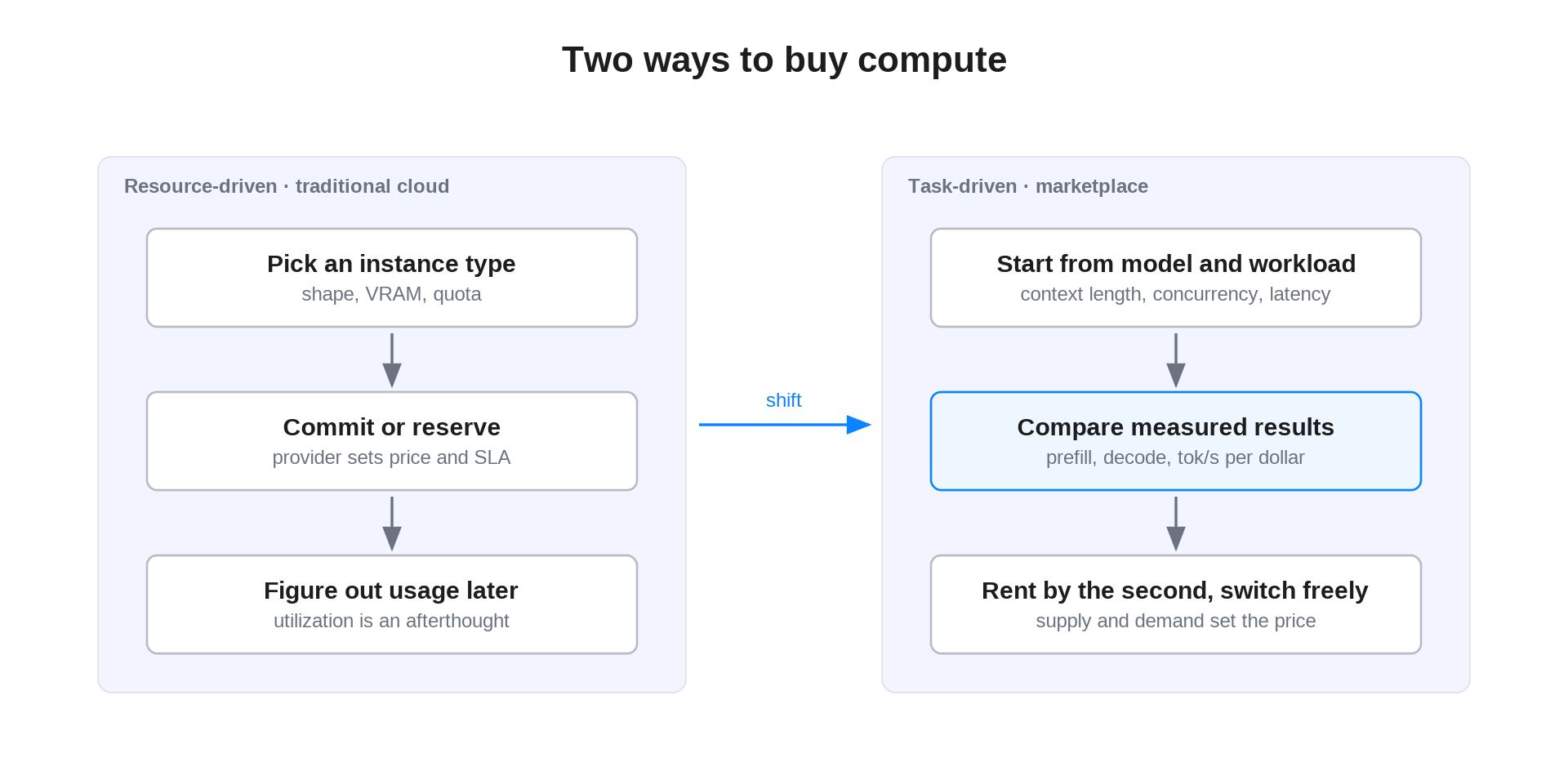
Traditional clouds sell certainty. Marketplaces sell choice.
The price of choice
Cheap comes with conditions
Interruptions
Vast.ai interruptible instances run on bidding. Get outbid and your instance is paused.
Uneven quality
New machines start at a 60% reliability score and earn the rest.
Tighter supply
Runpod's Community Cloud no longer accepts new hosts.
Balancing open supply against controlled quality is not easy.
Why leaderboards appear
The same model name does not mean the same result
- Two "RTX 4090 24GB" listings can differ in CPU, RAM, disk, network and cooling
- Vast.ai: a DLPerf score on every offer, and
vastai run benchmarks sorted by performance per dollar
- SemiAnalysis InferenceMAX: the datacenter-scale version, tokens per dollar and per megawatt
- qlsoulmate.com: treats inference measurements as content, with a self-serve speed test
A leaderboard turns "selling cards" into "selling proof."
How to read these numbers
From qlsoulmate.com's front page, self-reported
52.8 tok/s
Single-stream decode, four machines at TP4, DeepSeek-V4-Flash.
231 seconds
Cold prefill of a 300K-token prompt, about 1,300 tok/s.
9.75 seconds
p95 for 8 concurrent short requests over 3×400K windows.
- One vendor's own measurements, not an industry baseline
- The cost-efficiency ranking and side-by-side tests are labeled "phase two" and not live yet
Why spec sheets mislead
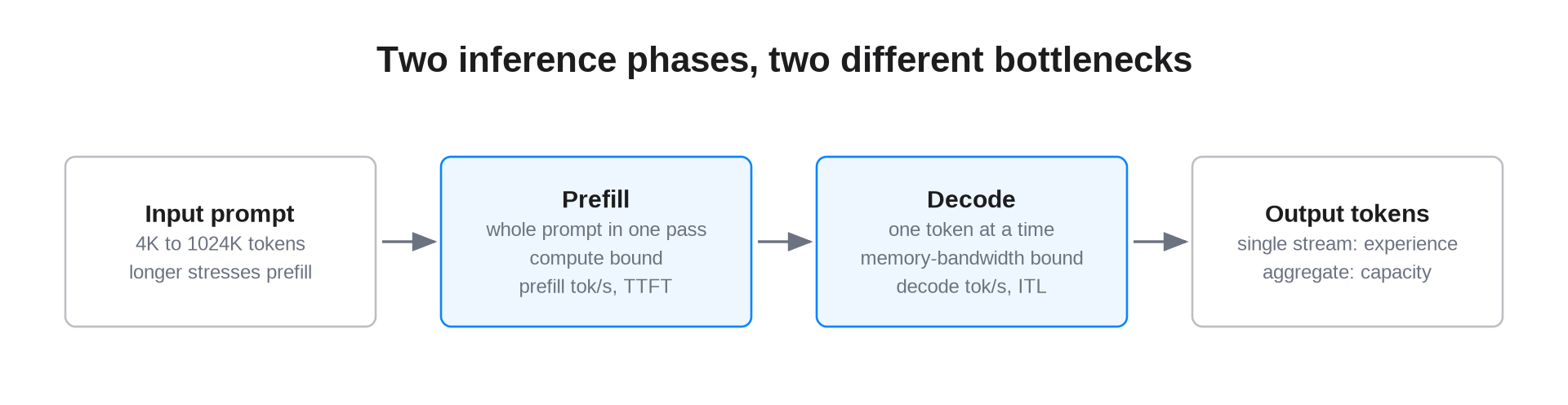
- VRAM tells you whether a model fits, not how fast it runs
- A 231-second cold prefill means almost four minutes to first token for long documents and coding agents
- MFU is Model FLOPs Utilization, a training metric, not memory-bandwidth utilization
A cheaper card is not always cheaper per token
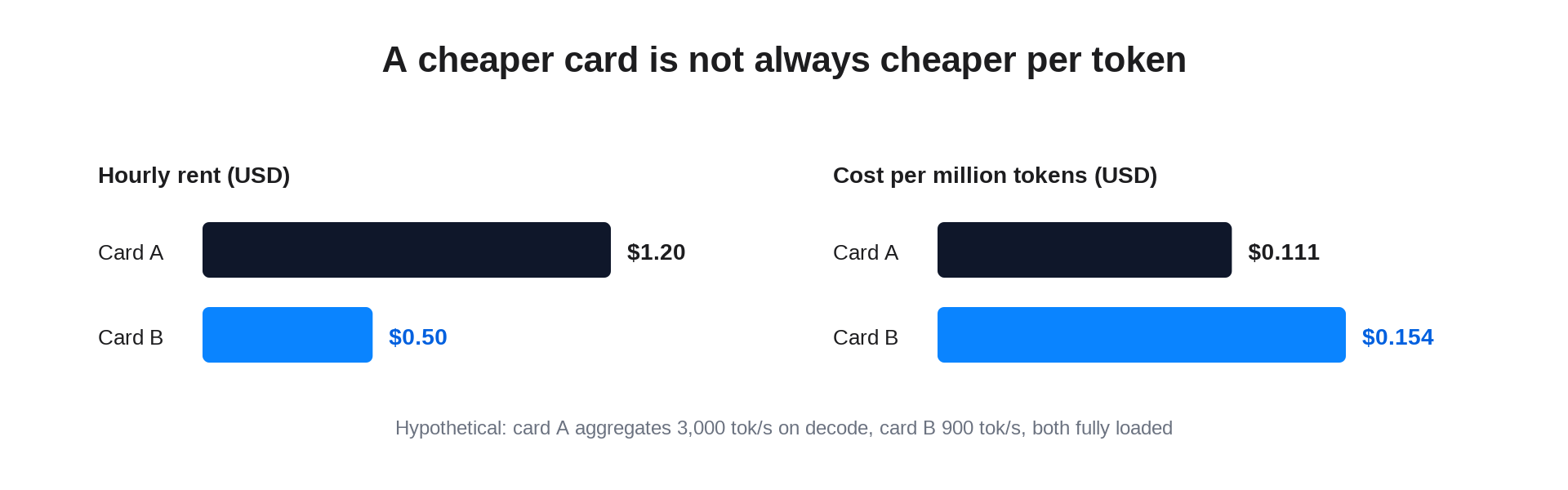
Comparing by the hour compares rent. Comparing by the token compares cost.
The metric assumes full load. Idle time is billed all the same, which brings us back to slicing and scheduling.
Beyond NVIDIA
Being listed and being usable are different things
The stacks differ
CUDA, ROCm and CANN are separate worlds. vLLM supports Ascend through a separate plugin.
Brittle version matrices
HAMi docs: Ascend hami-core mode is ARM only and needs driver 25.5 or later.
Thin public data
Reproducible prefill and decode numbers on open models are hard to find.
Half an Instinct and half an Ascend are not the same product.
We found a card. The card is too big.
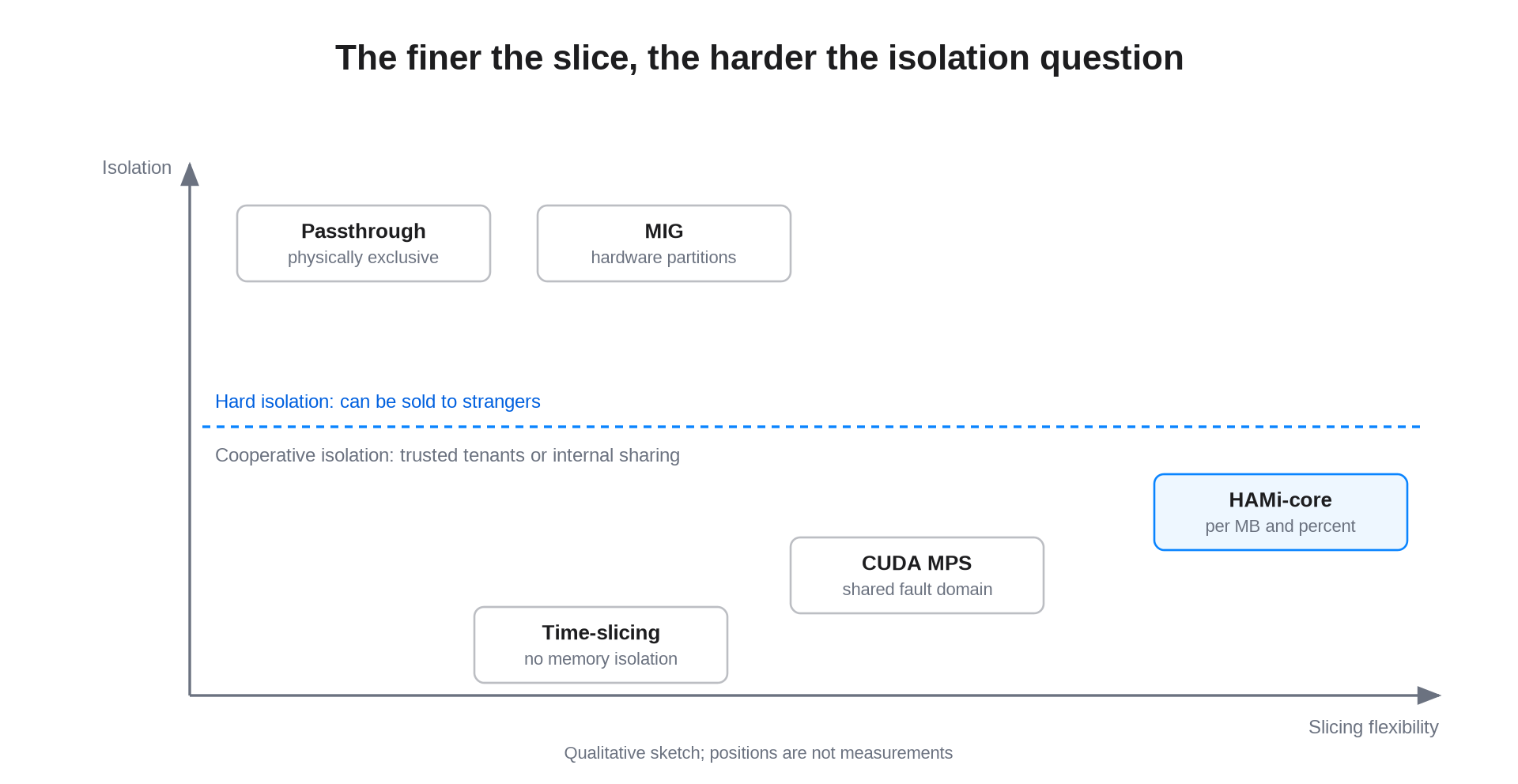
The finer the slice, the harder the isolation question
What it takes to sell slices
Granularity versus isolation
- Runpod: MIG slices of the RTX PRO 6000 at 24 GB and 48 GB, on Secure Cloud only
- Time-slicing: no memory or fault isolation between replicas, not for outside tenants
- HAMi-core: memory capped by the megabyte, compute throttled by time slice, no MIG required
- Boundary: for fully untrusted tenants, add MIG, a virtual machine or a sandboxed container
This trade-off decides what a card can be sold as.
The margin is decided in the middle
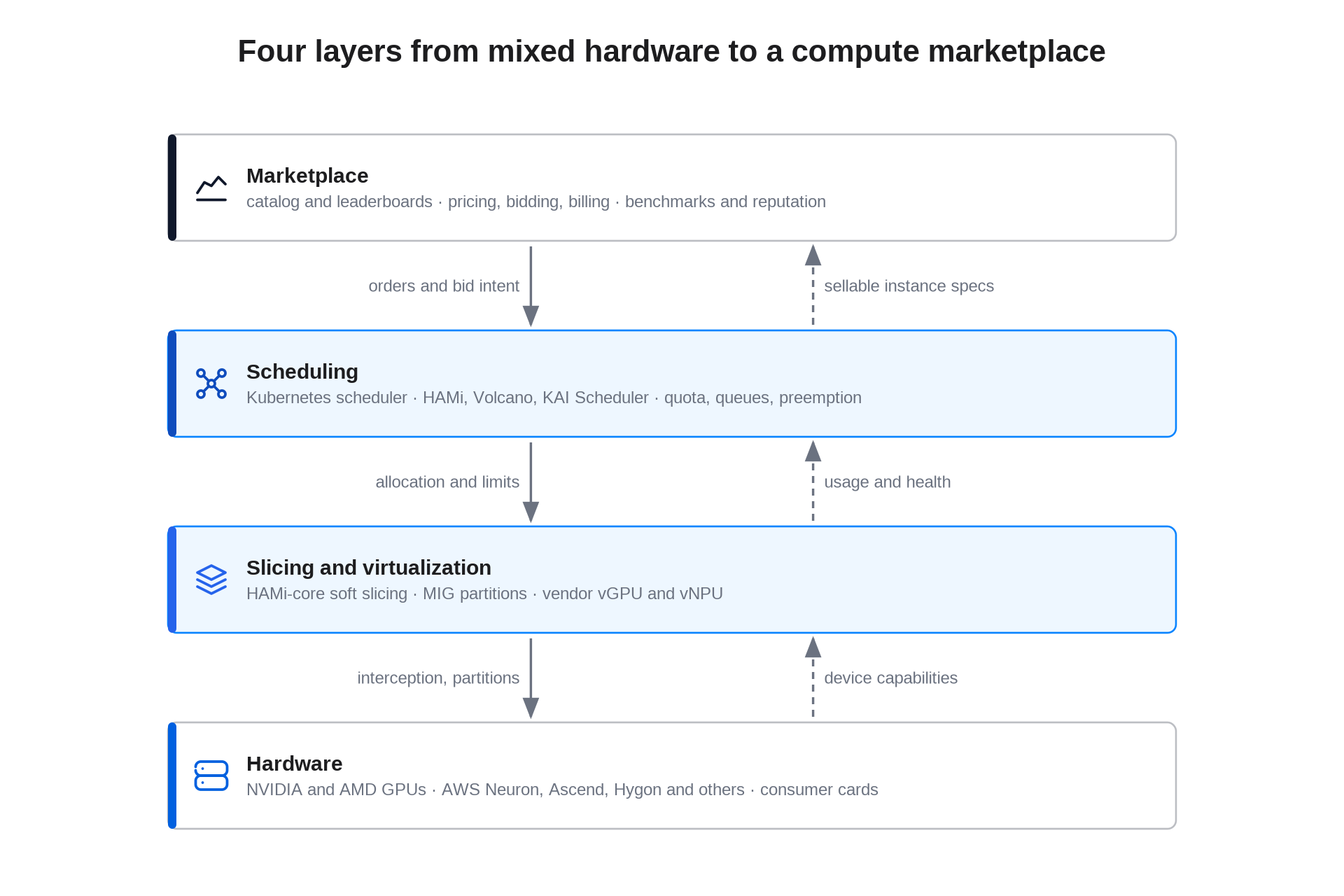
Virtualization cuts the card, scheduling fills it
- Sold whole, a card serves one tenant. Cut into four slices that all sell, it earns on a different scale
- HAMi v2.11.0 lists more than a dozen device types, a ready-made adaptation layer
- KAI Scheduler and Volcano vGPU keep their own scheduling and reuse HAMi-core for runtime isolation
Schedulers stay plural. The data plane is converging.
The missing interfaces
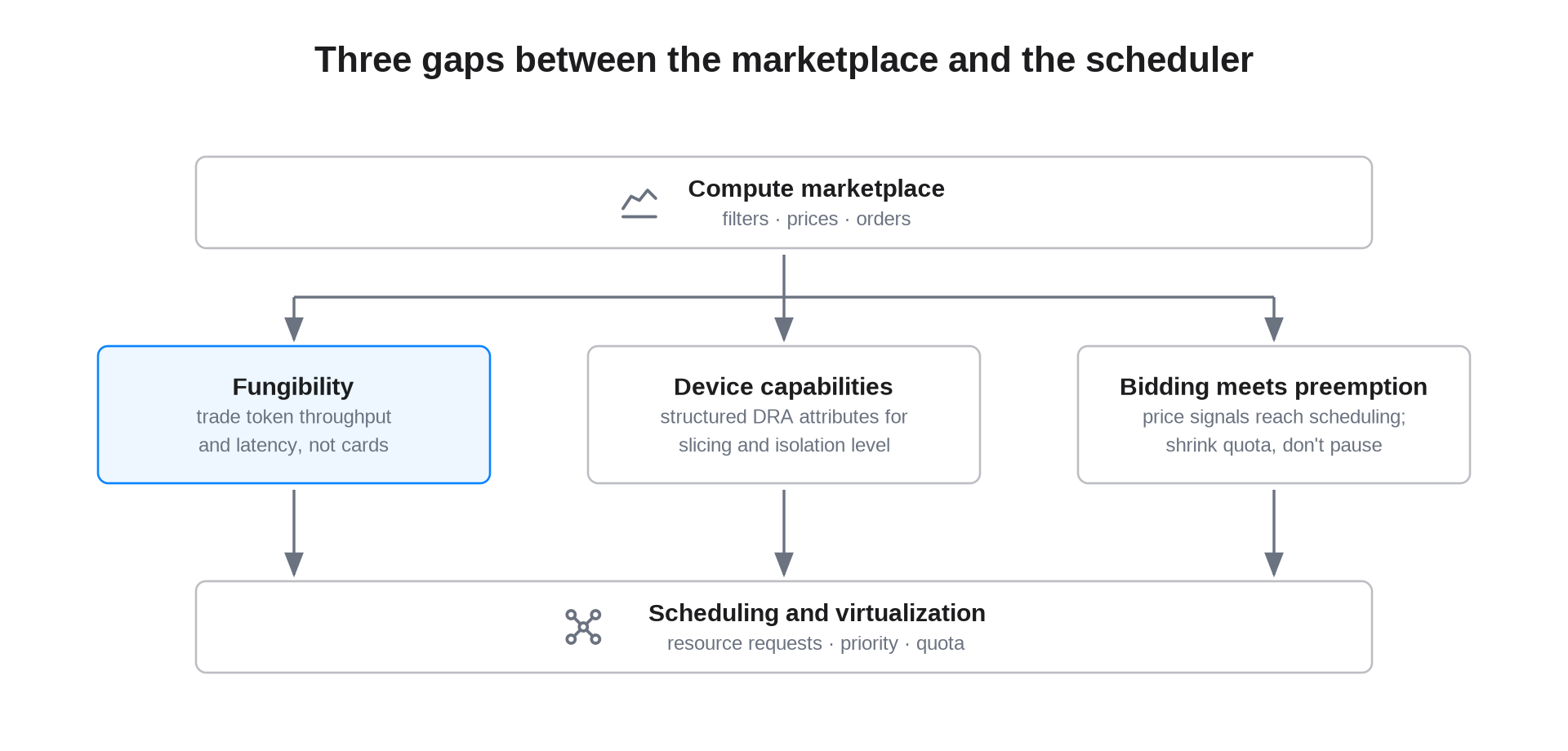
Who defines the methodology, who audits the data and who is liable all need industry agreement.
Summary
- Traditional clouds sell certainty, marketplaces sell choice
- Leaderboards answer an information gap, as long as the methodology is public
- Non-NVIDIA accelerators are held back by software stacks, version matrices and thin public data
- Cutting a card safely, selling it out and metering it depends on slicing and scheduling
- Standard interfaces are early: fungibility, device capabilities, bidding meets preemption
GPU scarcity is shifting from "cannot get one" to "cannot choose one."
A leaderboard produces no compute
More tokens per dollar come from the layers underneath
AI Infrastructure Notes · November 2026
Who Benchmarks the GPU?
Slicing and scheduling behind compute marketplaces
Renting a GPU now looks like a review site
From "can I get one" to "which one"
The old question
Can I get a GPU at all?
The new question
Which card, from which host, at what price?
The new storefront
Vast.ai, Runpod, TensorDock. In China, qlsoulmate.com adds rankings and measured results.
The contest moves from "who has the cards" to "who can prove this card is worth the price."
Two ways to buy compute
Traditional clouds sell certainty. Marketplaces sell choice.
The price of choice
Cheap comes with conditions
Interruptions
Vast.ai interruptible instances run on bidding. Get outbid and your instance is paused.
Uneven quality
New machines start at a 60% reliability score and earn the rest.
Tighter supply
Runpod's Community Cloud no longer accepts new hosts.
Balancing open supply against controlled quality is not easy.
Why leaderboards appear
The same model name does not mean the same result
- Two "RTX 4090 24GB" listings can differ in CPU, RAM, disk, network and cooling
- Vast.ai: a DLPerf score on every offer, and
vastai run benchmarks sorted by performance per dollar
- SemiAnalysis InferenceMAX: the datacenter-scale version, tokens per dollar and per megawatt
- qlsoulmate.com: treats inference measurements as content, with a self-serve speed test
A leaderboard turns "selling cards" into "selling proof."
How to read these numbers
From qlsoulmate.com's front page, self-reported
52.8 tok/s
Single-stream decode, four machines at TP4, DeepSeek-V4-Flash.
231 seconds
Cold prefill of a 300K-token prompt, about 1,300 tok/s.
9.75 seconds
p95 for 8 concurrent short requests over 3×400K windows.
- One vendor's own measurements, not an industry baseline
- The cost-efficiency ranking and side-by-side tests are labeled "phase two" and not live yet
Why spec sheets mislead
- VRAM tells you whether a model fits, not how fast it runs
- A 231-second cold prefill means almost four minutes to first token for long documents and coding agents
- MFU is Model FLOPs Utilization, a training metric, not memory-bandwidth utilization
A cheaper card is not always cheaper per token
Comparing by the hour compares rent. Comparing by the token compares cost.
The metric assumes full load. Idle time is billed all the same, which brings us back to slicing and scheduling.
Beyond NVIDIA
Being listed and being usable are different things
The stacks differ
CUDA, ROCm and CANN are separate worlds. vLLM supports Ascend through a separate plugin.
Brittle version matrices
HAMi docs: Ascend hami-core mode is ARM only and needs driver 25.5 or later.
Thin public data
Reproducible prefill and decode numbers on open models are hard to find.
Half an Instinct and half an Ascend are not the same product.
We found a card. The card is too big.
The finer the slice, the harder the isolation question
What it takes to sell slices
Granularity versus isolation
- Runpod: MIG slices of the RTX PRO 6000 at 24 GB and 48 GB, on Secure Cloud only
- Time-slicing: no memory or fault isolation between replicas, not for outside tenants
- HAMi-core: memory capped by the megabyte, compute throttled by time slice, no MIG required
- Boundary: for fully untrusted tenants, add MIG, a virtual machine or a sandboxed container
This trade-off decides what a card can be sold as.
The margin is decided in the middle
Virtualization cuts the card, scheduling fills it
- Sold whole, a card serves one tenant. Cut into four slices that all sell, it earns on a different scale
- HAMi v2.11.0 lists more than a dozen device types, a ready-made adaptation layer
- KAI Scheduler and Volcano vGPU keep their own scheduling and reuse HAMi-core for runtime isolation
Schedulers stay plural. The data plane is converging.
The missing interfaces
Who defines the methodology, who audits the data and who is liable all need industry agreement.
Summary
- Traditional clouds sell certainty, marketplaces sell choice
- Leaderboards answer an information gap, as long as the methodology is public
- Non-NVIDIA accelerators are held back by software stacks, version matrices and thin public data
- Cutting a card safely, selling it out and metering it depends on slicing and scheduling
- Standard interfaces are early: fungibility, device capabilities, bidding meets preemption
GPU scarcity is shifting from "cannot get one" to "cannot choose one."
A leaderboard produces no compute
More tokens per dollar come from the layers underneath